
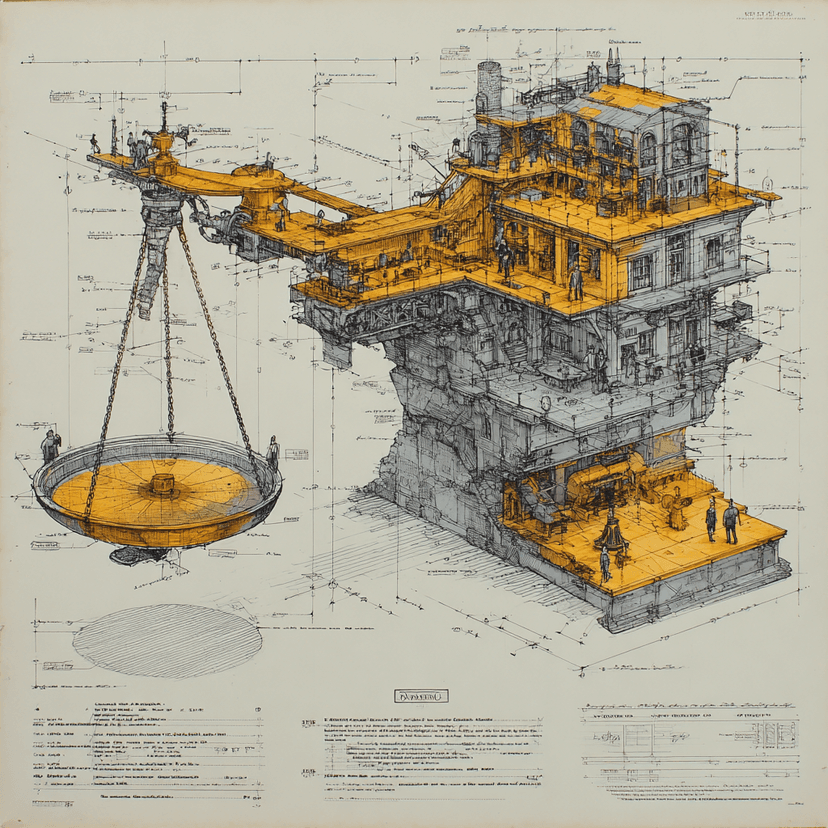
The Numbers That Never Lied
“I was surprised to find that the weights of the weights with which we weighed materials... had never been tested.”
Andrew Carnegie, Autobiography
The following section draws primarily from James Howard Bridge’s The Inside History of the Carnegie Steel Company (1903), written by Carnegie’s private secretary who had direct access to the cost ledgers, and Peter Temin’s Iron and Steel in Nineteenth-Century America (1964), the definitive economic analysis of the industry Carnegie conquered.
To understand what Carnegie built, you must first understand what existed before he built it, and why what existed could not survive what was coming.
In 1870, the American iron and steel industry was a chaos of small operators, family firms, and regional powers who competed on reputation, relationships, and the kind of luck that favors men who do not know how lucky they are. The Cambria Iron Works in Johnstown employed 4,000 men and dominated the Pennsylvania market.[2] The Bethlehem Iron Company supplied the Navy with armor plate.[2] A dozen smaller mills scattered across Pittsburgh produced rails, beams, and structural iron for the railroads pushing west. Collectively, American ironmakers produced 1.7 million tons annually, a quarter of British output, and most of them could not tell you, within twenty percent, what it cost them to produce a single ton.[3]
The ironmasters who ran these operations were craftsmen elevated by success, men who had learned their trade at the furnace mouth and risen through skill and force of personality to positions that demanded skills they had never developed.
Daniel Morrell[4] at Cambria had started as a clerk in 1855 and worked his way up over thirty years to control one of America’s largest ironworks, building worker housing, funding churches, governing his domain in the manner of a benevolent feudal lord who believed that knowing his men by name was superior to knowing his costs by the cent.
John Fritz[5] at Bethlehem could read a heat of steel the way a wine merchant reads a vintage: by color, by smell, by the particular quality of light reflecting off the molten surface, by the sound the metal made as it flowed, by signs that had taken decades to learn and could not be written down, transmitted through documentation, or taught to a man who had not spent years at the furnace mouth developing the instincts that separated master from journeyman.
These men knew their business in their bones, and the knowing was genuine, hard-won through years of work that left calluses on their hands and smoke in their lungs and judgment in their eyes that no accountant could replicate. They walked their floors. They knew their workers by name, their suppliers by reputation, their customers by handshake. They represented an approach to industrial management that had worked for a century and would be obsolete within a decade.
They were about to be destroyed by a man who knew none of these things, who had never made iron, never tended a furnace, never felt the heat that turned a mill floor into a kind of industrial hell where men aged twice as fast as the calendar recorded. Carnegie could not read a heat of steel by its color. He could not diagnose a rolling mill by its sound. He never walked a mill floor with the authority that thirty years of accumulated craft bestowed on men like Fritz and Morrell. What Carnegie could do was calculate, with precision his competitors had never attempted, what every ton of steel cost to produce, and then undersell them until they broke.
Carnegie stood five feet three inches tall.[6] He spent his life surrounded by men who towered over him, men who could have broken him with their hands, men whose physical labor built the fortune he would accumulate, and he dominated them all through sheer force of intellect applied to the problem of knowing what others could not know. The psychology of the small man who must win through superiority of mind rather than body shaped everything he built. The cost sheets were his telescope: they let him see farther than taller men who stood on their own mill floors and perceived only what their eyes could reach. Where John Fritz saw the color of molten steel, Carnegie saw the cost of the fuel that heated it, the wages of the men who tended it, the price of the ore that became it, the profit margin that justified it, all rendered in numbers that traveled by telegraph to wherever he happened to be.
His competitors, the men he would destroy, had advantages he would never possess. They understood the craft in ways that required a lifetime to develop. They had the respect of workers who saw them as fellow practitioners, men who had once stood where the workers stood and knew what the work demanded. They could walk a mill floor and diagnose problems by sound and smell that no ledger could capture, no report could transmit, no telegraph could carry across an ocean.
These advantages were real. They were also insufficient.
In industries where scale economics overwhelm craft knowledge, and steel was such an industry, where a ton of rails from Cambria was functionally identical to a ton of rails from Edgar Thomson, where customers bought on price and delivery rather than on the particular genius of the ironmaster who supervised production, the manager who sees the numbers defeats the craftsman who feels the work. In other domains, this formula inverts: try to mass-produce wine by the numbers, or reduce surgical skill to metrics, and you will learn the limits of quantification. But Carnegie had chosen his battleground with the instinct of a general who fights only where his advantages are decisive.
Daniel Morrell lived within sight of the Cambria stacks and could tell you the names of the men who worked each shift. John Fritz ate breakfast in view of the Bethlehem furnaces and could diagnose a heat of steel by its color. Carnegie could tell you, from a castle in the Scottish Highlands, from a hotel in New York, from a steamship in the middle of the Atlantic, what it cost to produce a ton of rails at Edgar Thomson down to the hundredth of a cent.[3] Morrell and Fritz, standing on their own mill floors, breathing the smoke from their own furnaces, could not tell you their costs within several dollars. The gap between knowing something to the hundredth of a cent and knowing it within several dollars is not a difference in precision. It is a difference in kind. The difference between owning a map and wandering lost. Carnegie’s competitors wandered.
The Counterfactual That History Forgot
Before proceeding to the system Carnegie built, consider the question that hagiographers never ask: was Carnegie necessary?
The standard narrative presents Carnegie as uniquely visionary, a man who saw what others could not see, who invented cost accounting through some combination of genius and immigrant hunger that his competitors, comfortable in their craft knowledge, simply lacked. The narrative flatters everyone: Carnegie becomes the hero, his competitors become the complacent incumbents, and we, the readers, get a clean story about how disruption works.
The deeper truth is that Carnegie was uniquely positioned. His railroad education gave him organizational tools that ironmasters literally could not have acquired because they had never worked where such tools were being invented. If Thomas Scott[4] had died before Carnegie joined the Pennsylvania Railroad, if Scott had never recognized the young telegraph operator’s talent, if Carnegie had started in the iron business instead of learning management at the most sophisticated enterprise in America, would the measurement revolution have happened anyway?
Almost certainly. Would it have happened through Carnegie? Perhaps not.
The trend lines pointed toward systematic cost accounting regardless of who implemented it first. The Bessemer process made steel production capital-intensive enough that owners needed to know their costs. The railroad expansion created demand for standardized products where price competition was inevitable. The telegraph made information transmission fast enough that remote management became possible. These forces were structural. Carnegie rode them; he did not create them.
Here is the uncomfortable question that Nassim Taleb would ask: how many cost-obsessed industrialists failed and we never heard of them? For every Carnegie who built a cost accounting empire, how many men implemented similar systems, ran similar calculations, and went bankrupt anyway because they bought the wrong ore deposits, or hired the wrong superintendent, or simply hit a recession at the wrong moment? The cemetery of forgotten capitalists is full of men who did everything right and failed because luck, that variable the ledgers cannot capture, turned against them. Carnegie’s success required his system. It also required the Panic of 1873 to destroy his competitors. It required the railroad expansion that created demand for his rails. It required a hundred contingencies that his autobiography carefully attributes to his own foresight rather than to the randomness that shapes all human affairs. The cost sheets could track waste per ton to four decimal places. They could not track the role of fortune in determining whose cost sheets would matter.
Carnegie’s genius was not in inventing what no one else could have invented; it was in being ready, when the moment came, to apply what he had learned to an industry that was ripe for transformation. The combination of preparation and circumstance is not reducible to either alone. Those who credit only preparation produce hagiography. Those who credit only circumstance produce fatalism. The truth lives in the uncomfortable middle, where exceptional individuals matter but do not matter as much as they believe.
Steel in 1870 was expensive, rare, and produced in small batches by craftsmen who guarded their knowledge because knowledge was the only thing that distinguished them from the laborers they supervised. The Bessemer process, invented in 1856 and improved by William Kelly in America, had begun to change this, but the change was uneven, contested, and poorly understood by the men who would be transformed by it.[2] British steelmakers led the world in technique. German steelmakers were catching up in science, applying systematic chemistry to problems the British solved through accumulated trial and error. American ironmakers still produced mostly iron, not steel, using puddling furnaces that had not changed fundamentally since the 1780s, because the capital required to convert to Bessemer production was enormous and the knowledge required to operate Bessemer converters was scarce and expensive.
The American iron industry was concentrated in Pennsylvania for reasons that had nothing to do with strategy and everything to do with geology: anthracite coal in the east, bituminous coal in the west, iron ore in the mountains between.[2] The railroads that connected these resources created the industry, and the industry supplied the railroads with rails, spikes, and structural iron. The circularity was not coincidental. It was the signature pattern of industrial America: industries creating their own demand, infrastructure building the infrastructure to build more infrastructure. American iron production was growing at fifteen percent annually while British production grew at three.[2] The trend lines were clear to anyone who bothered to calculate them. Carnegie bothered.
British ironmasters regarded their American competitors with a mixture of condescension and concern that would prove justified in ways they did not anticipate. The condescension arose from quality: American iron was inferior, American steel essentially nonexistent as a commercial product, American workmanship crude by the standards of Sheffield and Birmingham. The concern arose from scale: the Americans were catching up not through superior technique but through superior ambition, through the willingness to build furnaces twice as large as any sensible person would build, to hire workers with no training and burn them out in a decade, to sacrifice everything for volume because volume was what the American market demanded and American capital supplied.
Carnegie would weaponize this appetite for scale. He would add to it the precision that the British assumed Americans lacked and the ruthlessness that the British, for all their imperial experience, had never quite applied to their own industries. The result would be a company that by 1900 produced more steel than all of Britain combined.[6]
The Architecture of Visibility
“We made the stock-holder’s who-is-to-blame-for-this-poor-result exactly as if we were standing by his side.”
James Howard Bridge, on Carnegie's reporting system
The system Carnegie installed at his steel works came from an education his competitors could not have received because they had never worked where he worked, had never seen what he had seen, had never absorbed the organizational innovations that the Pennsylvania Railroad had pioneered in the decades before Carnegie turned his attention to steel. To understand the architecture he would build, you must first understand where he learned to build it.
Before Carnegie made steel, he made his living on the Pennsylvania Railroad, working under Thomas Scott, who ran the Western Division with a discipline borrowed from military logistics and adapted to the unprecedented challenge of managing an organization larger than any that had existed before the railroad age.
The Pennsylvania Railroad in the 1850s was the largest enterprise in America, larger than any government department, larger than the federal army, larger than anything that had existed before in the history of human organization.[7] It could not be managed by walking the tracks. The distances were too great, the operations too complex, the coordination requirements too demanding for any individual mind to hold. Scott managed it through paper: daily reports from every station showing tonnage moved, revenue collected, expenses incurred, equipment deployed, accidents recorded, delays explained. The reports flowed to division headquarters, were compiled and analyzed by clerks who could not have explained the operations they were measuring, then transmitted upward to executives who made decisions without ever seeing the trains whose movements they directed.
J. Edgar Thomson[4], the railroad’s president, had pioneered this system after studying the Prussian General Staff under Helmuth von Moltke[8], recognizing that the problems of managing a railroad and managing an army were structurally identical: how do you coordinate actions across vast distances when the people making decisions cannot see the operations they are directing?
Moltke’s answer was information flow: daily reports from every unit, analyzed at headquarters, decisions transmitted back through a hierarchy designed for speed and precision.[8] The army that cycled through this observe-orient-decide-act loop faster than its enemy would win, regardless of which general stood closer to the battlefield, regardless of which soldiers were braver, regardless of which cause was more just. Thomson recognized that railroads faced an analogous problem. Carnegie, watching both men, filed away a lesson that would not pay dividends for another fifteen years but would pay compounding dividends for the rest of his career.
Here is a detail that the Carnegie biographers usually miss: Thomson was not a military man. He was an engineer who had studied the Prussians because the Prussian system was published. Moltke believed that organizational methods should be made explicit, codified, transmitted through documentation rather than through the kind of tacit apprenticeship that characterized craft industries and made them vulnerable to disruption.[8] Thomson agreed. He wrote manuals. He created forms. He standardized reporting formats so that information from different divisions could be compared and aggregated. The Pennsylvania Railroad became, in effect, the first American corporation to operate on what we would now call bureaucratic principles, and Carnegie absorbed those principles before he could have named them, before anyone had named them, through simple proximity to men who understood what formal systems could accomplish that informal knowledge could not.
The ironmasters who would become Carnegie’s competitors had no such education. They had learned their trade the way their fathers had learned it: by watching, by doing, by accumulating the kind of knowledge that lives in the hands and eyes and cannot be written down or transmitted through telegraph. This knowledge was genuine. It was also doomed.
The Prussian Precedent and Its Warning: The measurement revolution in warfare preceded the measurement revolution in industry. Napoleon’s intendants tracked troop strength, supply consumption, and march rates with unprecedented precision, allowing him to concentrate forces at decisive points while enemies stumbled through fog.[9] Wellington’s Peninsula Campaign succeeded partly because his quartermasters tracked supplies more accurately than the French, allowing calculated retreats that preserved force while pursuing French armies dissolved into starvation.[10]
The Prussian example also contained a warning that Carnegie never absorbed. Frederick the Great built the most precisely measured military force of the eighteenth century. His inspections tracked not merely troop strength but posture, uniform condition, the angle at which muskets were held, the cadence of march. The Prussian army became a machine. When Napoleon’s unmeasured, chaotic, inspired army destroyed the Prussians at Jena in 1806, it proved that measurement without adaptation is brittleness, not strength.[11] Carnegie’s systems were never tested against an adversary who could break the rules he had defined.
What the Cost Sheets Actually Contained
This section draws primarily from James Howard Bridge’s The Inside History of the Carnegie Steel Company (1903), the only account written by someone with direct access to the cost ledgers, supplemented by the congressional testimony from the Homestead investigation (1892-1893), which forced Carnegie Steel executives to explain their accounting methods under oath.
In the summer of 1875, Captain William Jones[3] walked the floor of the Edgar Thomson Steel Works with a simple instruction: weigh everything.
Every pile of iron ore arriving at the furnaces would be weighed. Every ton of pig iron leaving them would be weighed. Every rail that rolled off the mill would be weighed, and every scrap of waste swept from the floor would be weighed and recorded in a ledger that would travel, by telegraph, to wherever Andrew Carnegie happened to be, whether that was a mansion in New York, a castle in Scotland, or a steamship somewhere in between.
Carnegie was usually not in Pittsburgh. He was in New York, managing his investments and his social position. He was in Scotland, fishing and golfing and entertaining British aristocrats who found him vulgar but fascinating. He was traveling through Europe with his mother, staying in hotels that cost more per night than his workers earned in a month.[6] His competitors found this strange, perhaps contemptible. How could a man run steel mills from across an ocean?
They asked the wrong question. The question was not how Carnegie could manage remotely. The question was how they could compete against a man who had converted operational knowledge into transmissible information, who had built a system that allowed him to see what they could not see even though they stood on their own mill floors breathing their own smoke.
Daniel Morrell lived within sight of the Cambria stacks and could tell you the names of the men who worked each shift. He ate dinner with his foremen, attended the weddings of their children, buried them when the furnaces claimed them. John Fritz ate breakfast in view of the Bethlehem furnaces, walked the floors twice daily, and could diagnose problems that no report could capture. These were the advantages of proximity, and they were real.
Carnegie could tell you, from a castle in the Scottish Highlands, what it cost to produce a ton of rails at Edgar Thomson down to the hundredth of a cent: $28.4167 in one quarter, $27.8932 in the next, the variance demanding explanation, the explanation revealing inefficiency, the inefficiency eliminated before Carnegie had touched a piece of steel or seen the furnace that produced it.[3] Morrell and Fritz, standing on their own mill floors, could not tell you their costs within several dollars. The gap was not precision. It was power.
The cost accounting system that made Carnegie’s remote management possible was designed by a man whose name Carnegie later tried to erase from the historical record, whose contributions Carnegie minimized when he could not ignore them, whose fate reveals something about Carnegie that the autobiography carefully conceals.
William Shinn[3] arrived at Carnegie’s operations in the early 1870s with a gift for seeing numbers where other men saw only smoke and confusion.
By contemporary accounts, he was the most capable industrial accountant in the country, a man who could walk through an operation and perceive the underlying arithmetic that others simply could not access, who could look at a pile of ore and calculate what it would cost transformed into rails before the first shovel had touched it. Carnegie recognized Shinn’s value within weeks of their meeting. Within months, Shinn had designed the cost accounting system that would become Carnegie Steel’s most enduring competitive advantage, a system that remained in use, with modifications, until U.S. Steel inherited it in 1901.[3] Within years, Shinn would be gone, ejected from the company he had made possible, clutching an arbitrator’s award for $18,000 while Carnegie kept the system that would generate hundreds of millions.
The gift and the fate were connected. Understanding how requires examining what Shinn actually built.
The Anatomy of the Cost Sheet
What made Shinn’s system revolutionary was not that it tracked costs, every business tracks costs in some fashion, but what it tracked, how it tracked, and what decisions the tracking enabled. Understanding this distinction is essential for anyone attempting to build information advantages in their own domain.
A typical cost sheet from Edgar Thomson in 1882 tracked forty-seven distinct cost categories for the production of steel rails.[3] Labor was broken into twelve subcategories: “Puddlers,” “Heaters,” “Rollers,” “Straighteners,” “Inspectors,” and seven others. Materials included not just the obvious inputs (ore, coke, limestone) but supplies that competitors barely noticed: grease for the machinery, replacement parts for the rolls, even brooms for the sweepers who kept the mill floor clear of the debris that could jam equipment and slow production.
The entry for “Waste, Broken Rails” was tracked to four decimal places: 0.0043 cents per ton in one period, 0.0051 in the next.[3] Someone, Shinn or one of his successors, had calculated that the 0.0008 cent increase represented $3,400 in annual losses and demanded an explanation. The explanation was found. The loss was corrected. The rails kept rolling.
Here is what Shinn tracked that Carnegie’s competitors did not:
1. Waste per ton to four decimal places. Competitors tracked waste, if at all, as an aggregate line item: “Loss and Spoilage.” Shinn broke waste into seventeen categories: broken rails, rejected heats, scale loss, spillage, equipment damage, and a dozen others. Each category pointed to a different operational failure. Aggregate waste told you nothing except that you were losing money. Disaggregated waste told you where, why, and how much, and therefore what to fix.
2. Fuel consumption per heat, not per day. Competitors who tracked fuel consumption at all tracked it by time period: how many tons of coke did we burn this week? Shinn tracked fuel consumption per heat, linking energy input to specific batches of output. This revealed which furnaces were efficient and which were not, which crews were skilled at managing the burn and which were wasteful, which ore sources required more energy to process (and should therefore be priced differently in negotiations with suppliers).
3. Labor hours per specific product, not aggregate. Competitors knew their total labor costs. Shinn allocated labor costs to specific products. Rails, beams, and structural shapes all emerged from the same mill, but they required different operations, different skills, different labor intensities. By tracking labor per product, Carnegie could price each product based on its true cost rather than averaging labor across the product mix. This precision let him bid aggressively on high-volume, low-margin products (rails) while maintaining margins on specialty products (structural shapes) where competitors, lacking the cost visibility, either overpriced and lost the business or underpriced and lost money without knowing it.
4. Comparative foreman efficiency. Every foreman received a monthly ranking comparing his department’s costs to every other department’s costs and to the same department’s costs in prior periods.[3] The rankings were distributed widely enough that everyone knew where they stood. A foreman whose costs were rising knew that his inadequacy was visible, not just to his superintendent, but to the general manager, to the partners, to the invisible readers in Scotland.
5. Equipment maintenance intervals and costs. Competitors treated maintenance as overhead, a cost of doing business that appeared in the accounts when equipment broke. Shinn tracked maintenance predictively, recording when each piece of equipment was serviced, what work was done, and how performance changed afterward. Patterns emerged: certain equipment required service every 2,000 heats; certain repairs extended useful life by predictable amounts; certain failures, if caught early, cost $200 to fix, but if allowed to progress cost $2,000 in downtime and replacement. The cost sheets turned maintenance from reactive firefighting into planned optimization.
6. Variance from expected performance. This was Shinn’s most sophisticated innovation. For each cost category, he established expected values based on historical performance. The cost sheets then reported actual values alongside the expectations, with variances highlighted for management attention.[3] A foreman whose actual waste exceeded expected waste by 0.0008 cents per ton faced a written demand for explanation. The demand traveled by mail if Carnegie was abroad, by telegraph if the variance was severe. No one knew exactly which variances Carnegie would notice or when. The uncertainty created vigilance.
The system was revolutionary in its granularity. Every process in the steel mill became a cost center. Every ton of ore that entered the furnace was tracked from purchase through consumption. Every pound of coke was recorded and allocated. Every hour of labor was charged not to labor in general, not to the department that employed the worker, but to the specific rails or beams or structural components that the labor produced.
The reports that emerged from this system allowed Carnegie to see, for the first time in the history of manufacturing, exactly where money was being made and where it was being lost. A furnace that looked productive might be revealed as wasteful when its fuel consumption was properly allocated. A foreman who seemed competent might be exposed as careless when the waste from his department was tracked and compared to his peers. A product line that appeared profitable might be shown to be bleeding cash once its true costs were allocated rather than averaged across the entire operation.
Before Shinn, steelmakers operated in aggregate darkness. They knew their total revenues and their total expenses. They knew, roughly, whether they were profitable. But they could not identify which furnaces were efficient and which were not, which products made money and which lost it, which foremen were assets and which were liabilities. The darkness was comfortable because it protected everyone: managers whose inefficiencies remained hidden, workers whose slack went unmeasured, executives whose decisions went unscrutinized.
Shinn’s system burned away the darkness. What it revealed was not always pleasant, but it was always useful to the person who controlled what was revealed and to whom.
Shinn’s Trap:[3] Having built the system that made Carnegie’s fortune possible, Shinn expected to share in that fortune. He had been promised a partnership interest. He had been given verbal assurances, the kind of assurances that men gave each other in an era before employment contracts became standard, when a handshake was supposed to mean something. He had devoted years to creating a system of immense value.
The system was complete. It was running smoothly. It no longer required Shinn to operate.
Imagine you are William Shinn in 1878. You have spent three years creating a system that no one else in American industry could have created. Carnegie has praised your work, promised you partnership, assured you that your future is secure. You have no contract. You have only words, handshakes, the assurances that men gave each other in an era when such assurances were supposed to mean something. Now Carnegie is changing terms. What leverage do you have? The system you built is already running. It no longer requires your unique capabilities to operate. Your value has transferred from your skills to Carnegie’s ledgers. The very precision you created now measures your dispensability.
Carnegie found reasons to force him out.
The dispute that followed was bitter and illuminating. Shinn accused Carnegie of “slavery” and “wilful, malicious mendacity,” strong words from an accountant, words that suggest the fury of a man who felt betrayed rather than merely disappointed.[3] He took the case to arbitration. The arbitrators, reviewing the evidence, awarded Shinn $18,000 plus a share of profits, a vindication of his claims that Carnegie had indeed promised what Carnegie later denied.[3] Carnegie paid the judgment. The amount was trivial to him, less than he spent on a month of travel. He moved on. The cost accounting system remained, compounding value for decades after Shinn had been forgotten.
The Shinn’s Trap Pattern: The most famous modern example is Eduardo Saverin at Facebook. Saverin provided the initial capital and business structure for Facebook, was diluted out after the company no longer needed his contributions, and sued for a settlement estimated at $1-2 billion.[20] Saverin’s case differs from Shinn’s in a crucial respect: Saverin retained equity throughout. His return, despite the dilution, was extraordinary. Shinn’s trap is more completely illustrated by technical co-founders who vest their knowledge before vesting their equity.
Consider Gary Kildall of Digital Research, whose CP/M operating system educated IBM about microcomputer software, then watched IBM give the contract to Microsoft.[21] The pattern is consistent: the person who creates the system that enables scale is rarely the person who captures the returns at scale. The system, once created, can be operated by others.
The lesson is not that knowledge workers should refuse to create value. The lesson is that the timing of compensation matters as much as its magnitude. Shinn was paid what his work was worth before he created it. He was not paid what it was worth after.
The pattern would repeat throughout Carnegie’s career. Andrew Kloman[3], the mechanical genius whose innovations in iron production had been essential to Carnegie’s early success, was forced out in 1876 under circumstances that the historian James Howard Bridge describes as “shabby.”
Thomas Miller[3] followed him.
The pattern was so consistent that Bridge, who had worked as Carnegie’s private secretary and had direct knowledge of the internal dynamics, concluded that Carnegie “could not brook an equal. Sooner or later, everyone who proved his real value to the concern was forced out of it, until at last the concern became absolutely his own creation.”[3]
disposable soma theory[19] The biologist Thomas Kirkwood has described a phenomenon in evolutionary biology called disposable soma theory. The body invests resources in reproduction rather than maintenance because, from the gene’s perspective, the individual organism is disposable. A vehicle for transmitting genetic information, not an end in itself. The germ line persists; the body withers.
Carnegie’s treatment of Shinn, Kloman, Miller, and others suggests an organizational parallel. The individual who builds the system is disposable once the system is built. The value transfers from the creator to the creation. The creator can be discarded, paid off, minimized in the historical record, while the creation continues compounding returns for whoever controls it.
The Panopticon and Its Successors
“One man is always kept at the works whose duty is to watch everyone else.”
John Fitch, The Steel Workers (1910)
This section draws heavily on John A. Fitch’s The Steel Workers (1910), part of the landmark Pittsburgh Survey, which documented working conditions at Carnegie’s mills fifteen years after Homestead. Fitch interviewed workers who would not speak to company representatives and accessed the human costs that the cost sheets were never designed to capture.
The philosopher Jeremy Bentham designed the Panopticon in 1791 as a prison architecture where a single guard in a central tower could observe all prisoners without the prisoners knowing when they were being watched.[22] The uncertainty of surveillance would produce self-regulation. Prisoners who never knew if they were being observed would behave as if they were always being observed. The architecture would create discipline without requiring constant enforcement.
Carnegie never read Bentham, but he reinvented the Panopticon for industrial purposes. The cost sheets that tracked every ton, every cent, every variance from expected performance created an architecture of visibility where workers never knew exactly which metric would trigger scrutiny, which variance would demand explanation, which shortfall would cost them their jobs.
The comparative reports that Shinn had designed created what a later generation would call gamification, but without the game’s pretense of voluntary participation. Every foreman received monthly rankings. Every department was stacked against every other department. Every furnace’s output was compared to every other furnace’s output, and the comparisons were shared widely enough that everyone knew where they stood.
The rankings created pressure that operated through shame rather than through direct coercion. A foreman whose numbers lagged knew that his inadequacy was visible. Not just to his superintendent, but to his peers, to the general manager, to the invisible readers in Scotland. He did not know exactly who was looking at his numbers or when, but he knew that someone was looking, always. The uncertainty about observation created the psychological effect of constant observation.
Imagine you are a foreman at Edgar Thomson in 1885. Your monthly report arrives on your superintendent’s desk alongside reports from eleven other foremen. You know, because everyone knows, that the bottom three performers will face scrutiny. You do not know where you rank until the rankings are posted. The productivity numbers for your shift are slightly below last month’s, and you remember that last month’s were slightly below the month before. The ratchet is visible to you now. What do you tell your men? Do you push harder, knowing the injuries that might follow? Do you explain the numbers, admitting that you face pressure you cannot control? Do you pretend everything is fine and hope the other foremen had worse months? The cost sheets do not capture this calculation. Carnegie, reading your report in Scotland, sees only the number. You see your career.
The gang system intensified the pressure through a mechanism that Carnegie may not have fully designed but certainly exploited. In rolling mills and other operations, workers were organized into crews that were paid collectively based on collective output.[12] “If one man is slow he reduces the tonnage and hence the earnings of a hundred other men,” Fitch observed in his 1910 survey.
The company did not need to monitor workers directly. Their colleagues did it for them. The foreman could delegate enforcement to the crew itself, and the crew, knowing that their income depended on collective output, applied pressure that no foreman could match. A manager who pushed too hard risked resentment and sabotage. A peer who lost money because of your inadequacy risked ostracism, and ostracism in a mill town where everyone knew everyone was a punishment worse than any the company could officially impose.
Carnegie had discovered what economists would later call peer monitoring[13]: the use of group incentives to make workers police each other.
The mechanism was efficient. It was also corrosive. The solidarity that might have enabled collective bargaining was undermined by collective compensation that set workers against each other. The friendships that might have made work bearable were poisoned by incentives that made your friend’s slow day your financial loss.
The Panopticon Persists: Carnegie’s architecture of surveillance has found new expression in the algorithmic management systems that now govern warehouses, call centers, gig platforms, and increasingly white-collar work.
JD.com’s warehouse operations in China represent the logical endpoint of Carnegie’s vision: facilities where robotic systems track human pickers through wearable devices, measuring steps taken, items retrieved, and bathroom breaks to the second.[14] The algorithm generates productivity targets that adjust dynamically based on historical performance, a digital ratchet that never forgets a peak output day. Workers report that the system creates a peculiar anxiety: they are competing not against each other but against their own past selves, against the best shift they ever worked, which becomes the baseline the algorithm expects forever.
Tyson Foods processing plants apply similar surveillance to meatpacking, an industry that has resisted automation because the irregularity of animal carcasses defeats robotic precision.[15] Human workers must process chickens and cattle at speeds that machines cannot match, and the company monitors them with cameras, line-speed trackers, and injury logs that critics argue discourage reporting rather than prevent harm. A 2016 Oxfam report documented workers wearing diapers because bathroom breaks threatened their productivity numbers, a detail that Carnegie’s cost sheets could not have captured because the cost sheets measured output, not human degradation.[15]
DHL’s algorithmic routing systems extend surveillance to workers who never enter a building. Delivery drivers receive routes optimized by machine learning algorithms that account for traffic patterns, package density, and historical completion times.[16] The algorithm knows how long each stop should take. The algorithm notices when drivers deviate from prescribed routes. The algorithm flags anomalies for human review. Drivers describe feeling “watched by the computer,” observed by an entity that sees more than any human supervisor could see but understands nothing about why a particular delivery took longer than expected.
The Conditions of the Watchtower
The question is not whether surveillance works. It works. Carnegie’s mills outproduced competitors. JD.com delivers packages at speeds that seem physically impossible. Tyson processes more chickens per facility than anyone believed feasible a generation ago. The question is what surveillance costs beyond what the metrics measure, and whether those costs are worth paying.
The Case for Tight Control: Surveillance advocates point to the efficiency gains that measurement enables. Carnegie’s costs fell consistently throughout the period of intensified measurement. JD.com delivers goods at lower cost than less-monitored competitors. The gains are real and measurable.
The counter-argument, that surveillance destroys morale, increases turnover, and undermines intrinsic motivation, is harder to quantify precisely because the things surveillance destroys are the things that cannot be easily measured. But the argument can be made with evidence.
Captain Jones’s eight-hour experiments demonstrated that reducing surveillance intensity (through shorter shifts that allowed workers to maintain concentration without monitoring) actually increased output per hour.[3] The productivity gains from motivated workers exceeded the productivity losses from reduced monitoring.
The Danaher Business System, developed over decades at the diversified industrial company, offers an alternative model: measurement as intensive as Carnegie’s, but oriented toward problem-solving rather than blame allocation.[17] When metrics decline, Danaher’s system asks “what process failed?” rather than “who failed?” The distinction sounds semantic but produces different organizational behavior. Workers who fear punishment hide problems; workers who expect support surface problems early, when they are cheaper to fix. Danaher’s approach treats measurement as diagnostic rather than punitive, and the company’s long-term returns suggest the approach works: Danaher stock has outperformed the S&P 500 by roughly 15x over thirty years.[37]
The pattern suggests a principle: surveillance succeeds when those being measured share in what the measurement produces. It degrades into extraction when the gains flow only to those doing the measuring.
Carnegie’s surveillance degraded because it was asymmetric. The workers were measured; the workers bore the costs of the measurement; the workers did not share in the gains. Danaher’s measurement succeeds because the system serves as a diagnostic mechanism rather than an extraction mechanism.
PLAYBOOK: The Watchtower’s Terms
The Mechanism: Measurement systems create power asymmetries. The party that controls what gets measured, how it gets measured, and who sees the results captures disproportionate value. The party that is measured but does not control the measurement becomes vulnerable to extraction.
The Playbook:
-
Measure what matters to all parties. Carnegie measured output per worker, which served his interests. He did not measure injuries per shift, which would have served workers’ interests. Comprehensive measurement systems track the costs borne by the measured as well as the benefits captured by the measurer.
-
Share the data. Information asymmetry is the source of extraction. When workers at Homestead could not verify the company’s cost claims, they could not negotiate effectively. Transparency about measurement results reduces the asymmetry.
-
Share the gains. The Danaher system works because workers participate in the problem-solving that measurement enables. Piecework systems like Lincoln Electric’s work because workers capture a substantial share of the productivity gains their effort creates.
-
Preserve exit and voice. Carnegie’s surveillance became extraction only after Homestead destroyed the union that could negotiate on workers’ behalf. Measurement systems require countervailing power to prevent degradation into exploitation.
When It Works: Industries with measurable outputs, repetitive tasks, and potential for substantial productivity improvement. Manufacturing, logistics, transaction processing.
When It Fails: Creative work, relationship-based services, complex problem-solving. Any domain where the metrics capture only a fraction of the value created and where optimizing the metrics undermines the value the metrics cannot capture.
The Warning: The same measurement system can be arena or prison, depending on the institutional context. The technology is neutral. The application is not.
The Eight-Hour Proof and Its Burial
“It is entirely out of the question to expect human flesh and blood to labor incessantly for twelve hours.”
Captain William Jones
Captain Jones proved something that Carnegie’s successors chose to forget. Through rigorous measurement, the same measurement that enabled surveillance and extraction, Jones demonstrated that eight-hour shifts produced more output per worker than twelve-hour shifts.
The logic was simple once you measured what mattered. Workers on twelve-hour shifts were exhausted by hour eight. Their productivity declined. Their defect rates increased. Their injury rates soared. The additional four hours of work produced less additional output than the first four hours had produced, and the degradation in quality and the increase in accidents cost more than the nominal wage savings from reduced headcount.
Jones measured what his predecessors had not bothered to measure: output per hour rather than total output. The results were unambiguous. In trials conducted at Edgar Thomson, eight-hour crews produced 7 to 12 percent more tonnage per man-hour than twelve-hour crews.[3] Defect rates fell by roughly a quarter. Injury rates dropped proportionally. When Jones calculated the full cost, including the hidden costs of rework, accidents, and equipment damage that exhausted workers caused, the eight-hour day was not merely humane. It was profitable.
Jones implemented eight-hour shifts at Edgar Thomson in the mid-1880s. Production increased. Quality improved. Injuries declined. The numbers were unambiguous. Carnegie approved because Carnegie followed the numbers.
Jones died in a furnace explosion in 1889.[3] The eight-hour day died with him.
Within two years of Jones’s death, the twelve-hour day had returned to Edgar Thomson. The successors who replaced Jones did not conduct new experiments. They did not prove Jones wrong. They simply stopped measuring the things that Jones had measured: defect rates, injury rates, productivity per hour rather than total output. They measured total production and total cost, and the twelve-hour day looked better on those metrics because the costs it imposed were borne by workers and their families rather than by the company’s income statement.
The lesson is not that measurement failed. The lesson is that measurement serves whoever controls what gets measured.
Kellogg’s Six-Hour Proof: The same pattern played out at Kellogg’s Battle Creek plant, with different results because different institutional constraints were in play.
In 1930, W.K. Kellogg implemented a six-hour workday at his cereal plant, not as an experiment but as a permanent change.[18] Workers would work six hours at eight hours’ pay. The logic was partly humanitarian (Kellogg was a social reformer) and partly economic (Kellogg believed rested workers would be more productive).
The experiment ran for almost fifty years.
Production increased by approximately 4 percent per labor hour.[18] Worker turnover dropped to near zero. Quality improved measurably, reject rates fell by roughly a third. Women could enter the workforce because childcare became manageable around a six-hour schedule. The town of Battle Creek was transformed as workers had time for civic engagement, education, and family life that the standard industrial schedule had stolen.
The experiment ended in 1985, not because it failed economically but because corporate priorities changed.[18] New management, less committed to Kellogg’s social vision, chose to maximize utilization of fixed capital rather than worker welfare. The eight-hour day returned.
The parallel to Carnegie’s mills is instructive. Both experiments produced similar results: shorter hours increased productivity and quality. Both experiments were terminated not because the results were wrong but because the people who controlled the measurement changed and the new controllers valued different things.
The Ratchet Effect:[12] Workers were paid by the ton. Output was measured daily, weekly, monthly, annually. When workers achieved record production in March, that record became the baseline expectation for April. “What is done in March and October is of course possible in April and November,” Fitch noted acidly. The ratchet turned only one direction. Records were celebrated when set. They were expected forever after.
The tonnage rates that determined worker pay were adjusted downward whenever productivity increased, on the theory that improved equipment and methods had made the work easier. The workers bore the cost of the improvements while the owners captured the gains. A man who had produced 1,000 tons per month at a dollar per ton would be asked to produce 1,200 tons at 80 cents per ton.[12] His total pay remained roughly constant. His effort had increased by twenty percent. The company had captured the productivity gain that his effort, combined with capital investment, had created.
By 1907, when Fitch conducted his survey, only 0.7 percent of Carnegie Steel employees worked eight-hour shifts.[12] The eight-hour day that Captain Jones had proven viable was a memory, preserved in the cost sheets that Carnegie still maintained but no longer acted upon because acting upon them would have reduced profits and required acknowledging that extraction was a choice, not a necessity.
What Frick Could See
“We all approve of anything you do, not stopping short of a complete victory.”
Andrew Carnegie to Henry Clay Frick, before Homestead
The battle at Homestead on July 6, 1892, has been told many times in many ways. What the cost sheets reveal is why the battle happened.
In 1891, Carnegie Steel employed approximately 3,800 workers at Homestead.[24] Total wages were roughly $2.3 million annually. The proposed wage reductions, if fully implemented, would have saved approximately $400,000 per year. Against profits of $4.3 million, this represented a 9.3 percent improvement in profitability, real money, certainly, but not survival money, not necessity money, not the kind of money that justifies armed conflict, the deployment of 300 Pinkerton agents, the deaths of workers and guards, the deployment of 8,000 state militia, the destruction of a union that had represented 24,000 steel workers.
The $400,000 in direct wage savings was the number the company could defend publicly. The true calculation was larger and carefully obscured.
Once the union was broken, Carnegie could implement changes that the union had blocked for years. The eight-hour day that Captain Jones had proven viable could be replaced with the twelve-hour day that Jones’s successors preferred. The sliding scale floor that protected workers against wage cuts during recessions could be eliminated entirely. The tonnage rates that workers had negotiated through decades of collective bargaining could be reset unilaterally.
The true value of breaking the union was not $400,000 annually. It was millions of dollars annually, compounding year after year, for as long as labor remained unorganized. The cost sheets revealed this opportunity with precision that no prior generation of industrialists could have achieved. Carnegie could calculate what Homestead was worth to the company with three significant digits. The workers could only feel what Homestead would cost them.
By November 1892, the strike was broken.[6] The Amalgamated Association, which had represented 24,000 steel workers in 1891, saw its membership collapse to 10,000 by 1894, to 6,300 by 1909.[12] Carnegie Steel systematically eliminated the union from every one of its facilities. The calculation that the cost sheets had enabled was executed in full.
Information asymmetry had been Carnegie’s competitive weapon against other steel companies. He knew his costs when they knew only approximations. He could price accurately when they could only guess. He could survive recessions when they could not calculate how long their cash would last.
At Homestead, the same information asymmetry became a weapon against workers.
The company claimed the wage reductions totaled fifteen percent, a painful but survivable cut. Hugh O’Donnell, chairman of the advisory committee representing the Homestead workers, testified that the actual reductions ranged from twenty-two to thirty-five percent, depending on specific tonnage rates.[24] The discrepancy was not accidental, not a miscalculation, not a difference of interpretation.
Frick controlled the cost data. The workers could only calculate backward from their own paychecks, comparing what they had earned with what the new rates would pay. The company saw the full picture: every cost, every margin, every alternative, every consequence of acceptance or resistance. The workers saw only their portion of it, the portion the company chose to reveal.
Now imagine you are a skilled heater at Homestead, making roughly $2,400 per year, good money, enough to support a family, buy a house, save for your children’s future.[12] The company has offered a wage reduction of somewhere between fifteen and thirty-five percent, depending on calculations you cannot verify with numbers you cannot access. You do not know if the company is genuinely struggling or simply capturing surplus. You do not know if the Amalgamated Association can sustain a strike. You do know that the Pinkertons are coming, that the state militia has been called, that men with guns are arriving on barges. What do you risk? Your job, certainly. Your home, possibly. Your life, conceivably. The men beside you are facing the same calculation, and their decisions will affect yours. Carnegie, in Scotland, has calculated what Homestead is worth to three significant figures. You can only calculate what Homestead is worth to you.
Carnegie knew. He was in Scotland, fishing at Cluny Castle, when the Pinkerton barges arrived at Homestead.[6] But he had approved the Pinkerton contract before leaving America. He had written to Frick: “We all approve of anything you do, not stopping short of a complete victory.”
The instruction was clear. The distance was strategic, designed to preserve his public image as labor’s friend, as the author of Triumphant Democracy, as the immigrant who had risen from poverty and understood the working man, while his lieutenant broke labor’s back with methods Carnegie preferred not to witness.
The Gospel of Costs Meets the Gospel of Wealth
“The man who dies rich dies disgraced.”
Andrew Carnegie, The Gospel of Wealth (1889)
Carnegie’s philanthropic philosophy is documented in his 1889 essay “The Gospel of Wealth,” supplemented by his autobiography (1920, published posthumously) and the exhaustive records of the Carnegie Corporation of New York. The numbers that follow draw from the Carnegie Corporation’s historical records and Burton Hendrick’s authorized biography (1932).
The libraries were built with cost sheets.
This is the truth that Carnegie’s philanthropy could never quite escape, and the truth that Carnegie himself could never quite confront. The 2,509 libraries scattered across the English-speaking world, from Pittsburgh to Edinburgh to Fiji, were purchased with fortunes accumulated through the measurement revolution he had pioneered.[28] The Gospel of Wealth, that manifesto of philanthropic obligation published in 1889, three years before the blood at Homestead, was the intellectual superstructure erected upon the foundation of the Gospel of Costs.
Without the one, there could not have been the other. Carnegie understood this even if he chose not to dwell on it.
“Watch the costs and the profits will take care of themselves.” The profits took care of themselves so thoroughly that Carnegie became, by some measures, the wealthiest man in the world. When he sold Carnegie Steel to J.P. Morgan in 1901 for $480 million, the check that Morgan’s representatives handed him was the largest single payment to an individual in history to that date.[6] Carnegie reportedly looked at the number, nodded, and said nothing. The sum represented more than the entire federal budget had been when Carnegie started his business career.
Wealth, Carnegie believed, created obligations that most wealthy men shirked. The rich man was not an owner but a trustee, holding surplus capital temporarily, obligated to deploy it for the public benefit before death. “The man who dies thus rich dies disgraced.”
Carnegie spent the last eighteen years of his life racing that dictum, and the race tells us something about the nature of compound interest. He gave away approximately $350 million, an unprecedented sum, to causes he believed would multiply benefits across generations.[6] Libraries occupied first place because libraries had transformed his own life.
Colonel James Anderson[4], the retired manufacturer who had opened his private collection to working boys in Allegheny City, had given young Andrew access to books that shaped his mind and ambitions.
Carnegie remembered the gift. He repaid it at industrial scale, the way he did everything.
The Failed Ledger of Redemption
But here is what the philanthropy could not resolve, what no ledger could balance: the libraries were built with the same methods that had crushed the workers who might have used them.
Carnegie built a library in Homestead. The library that opened in 1898, six years after the battle, six years after the union was destroyed, six years after wages fell and hours extended.[27] The workers used it. They checked out books. They educated themselves. Some of their grandchildren probably attended Carnegie Mellon, funded with the same fortune.
Imagine you are a library patron in Homestead in 1902. You are the son of a puddler who lost his job after the strike. Your father never speaks of it, but you know the story from your mother, told in whispers after he has fallen asleep exhausted from a twelve-hour shift. You walk into a building paid for by the man who broke your family, marble floors, stained glass, the smell of new books, and you check out a volume that will help you pass the civil service exam, that will let you leave this town forever. What do you feel? Gratitude? Rage? Both? The building does not care. It is filled with books. The books do not know who paid for them.
The Gospel of Wealth proposed that the rich should give away their fortunes. The Gospel of Costs revealed how those fortunes were accumulated. The two gospels were inseparable, and the separation Carnegie attempted, the claim that he made the fortune one way and would spend it another, was a form of accounting that does not balance.
The Philanthropy Paradox Persists: The pattern Carnegie established has repeated with variations ever since. Consider the spectrum:
Alfred Nobel, the Swedish chemist who invented dynamite, spent his final years troubled by the uses to which his invention had been put. When a French newspaper published a premature obituary calling him “the merchant of death,” Nobel was reportedly devastated by the prospect of being remembered only for destruction.[29] His response was the Nobel Prizes, a philanthropic foundation designed to reward contributions to humanity. The prizes became among the most prestigious awards in the world. They could not make the dynamite unexplode.
The Sackler Family built a pharmaceutical fortune on OxyContin, aggressively marketing the opioid while downplaying its addictive properties, contributing to an epidemic that has killed over 500,000 Americans.[30] The family simultaneously funded museums, universities, and galleries across the world, naming wings after themselves with contributions derived from the same sales that fueled the crisis. The Louvre removed the Sackler name in 2019.[30] The Metropolitan Museum did the same in 2021.[30] The philanthropy that was meant to secure the family’s reputation instead became evidence of the reputation’s hollowness.
John D. Rockefeller, Carnegie’s contemporary and rival for the title of wealthiest American, built Standard Oil through practices that even Carnegie considered ruthless, secret railroad rebates, predatory pricing, industrial espionage that made Carnegie’s cost accounting look quaint.[31] Rockefeller’s philanthropy, channeled through the Rockefeller Foundation, transformed public health, funded universities, and helped eradicate hookworm from the American South. The genuine good was real. The extraction that funded it was also real. The ledger admits no simple sum.
Leopold II of Belgium extracted rubber from the Congo through a system of forced labor, mutilation, and mass death that may have killed ten million people.[32] He used the fortune to fund public works in Belgium: parks, museums, grand boulevards that tourists still admire. When the atrocities became public, Leopold defended his philanthropy: look what I have built, look what I have given. The buildings remain. So do the photographs of Congolese workers with severed hands.
The comparison across these cases, Carnegie to Nobel to the Sacklers to Rockefeller to Leopold, illuminates a spectrum rather than equivalence. Carnegie was not Leopold; his workers were exploited but not mutilated; his extraction was economic rather than colonial; his victims died of exhaustion and industrial accidents rather than systematic murder. But all five demonstrate the same failed ledger: the belief that what you give can balance what you take, that the books can be closed, that philanthropy is currency convertible with extraction.
It is not. The dead cannot vote on whether their sacrifice was worthwhile. The libraries are real. The costs were also real. The ledger does not balance because some things cannot be repaid.
The Ledger That Does Not Balance
The libraries remain. Two thousand five hundred and nine of them, scattered across the English-speaking world, from Pittsburgh to Edinburgh to Fiji.[28] Children who will never know Carnegie’s name will learn to read in rooms he built, discover books that change their lives on shelves he funded, become people they could not otherwise have become because a small man with a large fortune believed that access to knowledge was the debt the rich owed the poor.
The methods remain. Cost accounting is now so universal that we forget it was once invented. Every company that tracks performance, analyzes variance, identifies exceptions, manages by the numbers is building on foundations Carnegie laid. The measurement revolution transformed manufacturing, then services, then knowledge work. Algorithms now measure what Carnegie measured manually. The precision has increased by orders of magnitude. The fundamental question has not changed.
The question is not whether to measure. Organizations that do not measure will be displaced by organizations that do. The question is what surrounds the measurement: what countervailing forces ensure that the measured have voice in their measurement, what institutions prevent the slide from efficiency into extraction, what constraints keep the tools in service of creation rather than capture.
Carnegie did not ask that question. He built the tools and let others determine what the tools were for. Some successors used them wisely. Captain Jones proved that measurement could serve workers as well as capital. Schwab proved that visibility could be arena rather than prison. Danaher proved that intensive measurement and fair treatment were not contradictions. Kellogg proved that efficiency and humanity could coexist until the controllers changed.
Others did not. The speeding-up system evolved into algorithmic scheduling that optimizes labor to the minute. The twelve-hour day evolved into gig work without benefits or stability. The espionage that kept “one man in each ten” under suspicion evolved into surveillance software that watches every keystroke, every bathroom break, every moment when a worker pauses. The shadow spread with the methods, because the methods are neutral but the hands that wield them are not.
Consider a small example that captures the paradox. In 2019, a Teleperformance call center worker in the Philippines needed a bathroom break during peak hours.[25] The keystroke-tracking software registered her absence from her workstation. The system logged the duration: four minutes and thirty-seven seconds. A notation appeared in her productivity file, one of several such notations that month. Her supervisor received an automated alert flagging her “utilization rate” as below target. She returned to work faster than her body wanted because the cost of the break was now visible in ways that the cost of not breaking was not.
This is Carnegie’s legacy made digital. The cost sheets could track the waste from broken rails to four decimal places. They could not track what twelve-hour shifts did to the men who worked them. The keystroke logger can track a bathroom break to the second. It cannot track what surveillance does to the humans who live under it. The things that can be measured tend to drive out the things that cannot be measured.
Ford’s Sociological Department, established in 1914, represents the logical extension of Carnegie’s surveillance to workers’ private lives.[26] Ford’s five-dollar day, double the prevailing wage, came with conditions: investigators would visit workers’ homes to verify that they were living “properly,” that they were not drinking, that their houses were clean, that their families were in order. The measurement that Carnegie had confined to the mill floor followed workers home. The boundary between work and life dissolved under the pressure of managerial scrutiny. Ford eventually abandoned the program, not because it was wrong but because it was expensive. The impulse behind it, the belief that workers’ entire existence could be optimized for production, never disappeared. It simply went digital.
Worker exhaustion cannot be measured as precisely as tonnage. Family stability cannot be tracked to four decimal places. The gradual erosion of dignity that accompanies measurement without representation has no line item in the cost sheet.
And so the things that cannot be measured are, slowly, systematically, inevitably, sacrificed to the things that can.
Watch the costs, Carnegie instructed. The profits will take care of themselves.
What he did not say, what the cost sheets could never capture, was that the costs include the humans who generate them, and that those humans have no voice in the calculation unless someone builds systems that give them one.
Carnegie gave us the tools. He did not give us the wisdom to use them well. That wisdom cannot be funded like a library or endowed like a university. It must be fought for, generation after generation, by the people who understand what measurement can take as well as what measurement can give.
The workers at Homestead understood. They lost.
The tools Carnegie built are everywhere now: in the algorithms that schedule shifts at fulfillment centers, in the metrics that evaluate teachers and doctors and engineers, in the dashboards that reduce human work to colored cells in spreadsheets. The precision has increased by orders of magnitude. The fundamental question has not changed.
Every organization that measures faces the choice that Carnegie and Frick and Jones and Schwab faced: what will the numbers be used for? Will they illuminate or weaponize? Will they serve the people being measured or only the people doing the measuring?
Carnegie gave us no guidance. He built the tools and walked away, to Scotland, to his libraries, to his philanthropy, to the peace he made with himself that the rest of us are not obligated to accept.
The choice remains.
Portable Playbooks
PLAYBOOK 1: The Fog of Industry
The Mechanism: Superior information creates negotiating leverage, pricing power, and strategic flexibility. The party that sees clearly while others estimate captures value in every transaction. But information advantage is not merely about having more data, it is about knowing which data creates asymmetric insight.
Carnegie’s Application: Cost sheets that revealed true costs to the hundredth of a cent when competitors knew only approximations. Enabled aggressive pricing during recessions, strategic acquisitions of distressed competitors, and superior contract negotiation.
What Shinn Tracked That Competitors Could Not See:
| Category | Carnegie’s Granularity | Competitors’ Visibility | |----------|----------------------|------------------------| | Waste | 17 categories to four decimal places | Single “Loss & Spoilage” line item | | Fuel | Per heat, linked to specific crews | Per time period, aggregate | | Labor | Per product, allocated to specific outputs | Total labor, averaged across product mix | | Foreman efficiency | Monthly comparative rankings | Subjective annual assessments | | Maintenance | Predictive intervals, cost per repair | Reactive, expense when equipment fails | | Variance | Actual vs. expected, with explanation required | No systematic tracking |
The Steps:
-
Identify the information that matters. Carnegie tracked costs per unit, not total costs. The distinction determined everything. Per-unit costs enabled comparison and optimization; total costs enabled only aggregate assessment. Ask: which metrics would give you predictive insight versus merely descriptive reporting?
-
Build systems to capture information reliably. Shinn’s forms standardized reporting across forty-seven cost categories. Standardization enabled comparison across time and operations. Without standardization, data becomes noise, signals lost in inconsistency.
-
Create feedback loops that enable action. Information without action is overhead. Carnegie’s daily reports went to someone empowered to act on variances immediately. A 0.0008 cent increase in waste per ton triggered investigation within days, not quarters.
-
Maintain asymmetry deliberately. Information advantage persists only as long as competitors lack access. Carnegie’s cost systems were closely guarded trade secrets. He published his philosophy; he never published his cost sheets.
Modern Application:
The clearest parallel is not Amazon, whose information advantages have been widely analyzed, but three less-examined cases where information asymmetry creates systematic value capture:
Booking.com’s hotel data asymmetry. Booking.com knows, for every property in its system, the precise relationship between price, occupancy, and booking lead time.[34] It knows which price points trigger impulse bookings and which trigger abandonment. It knows how a property’s performance compares to every other property in the same city at the same star rating. Hotels know only their own booking patterns. The asymmetry determines commission rates: Booking.com can calculate precisely what a hotel would lose by leaving the platform, while hotels can only estimate what they would gain. Hotels that negotiate aggressively based on their own data are negotiating blind.
OpenTable’s restaurant leverage. OpenTable tracks not just reservations but no-shows, average check sizes, party composition, and return-customer frequency across every restaurant in its network.[35] When a restaurant asks OpenTable to reduce its per-cover fee, OpenTable can calculate, with precision the restaurant lacks, exactly how much revenue OpenTable drives to that specific restaurant versus walk-ins and other channels. The restaurant knows it gets reservations through OpenTable; OpenTable knows exactly what percentage of total covers, at what average spend, with what customer lifetime value. The information asymmetry is the source of OpenTable’s negotiating leverage.
Sysco’s food distribution data. Sysco, the dominant U.S. food distributor, knows what every restaurant in America buys, at what price, in what volume, with what seasonal variation.[36] Independent restaurants know only their own purchasing patterns. Sysco can see which restaurants are thriving (increasing orders, more premium ingredients), which are struggling (cutting portions, switching to cheaper suppliers), and which are ripe for upselling specific products. Sysco’s sales representatives arrive at negotiations with a complete picture of the restaurant’s purchasing history and competitive alternatives. Restaurant owners negotiate with partial information against an adversary that sees the full board.
When It Works: Competitive industries with many participants, standardizable products, and high transaction volumes. The value of information scales with the number of decisions it informs.
When It Fails: Domains where information cannot be standardized, where competitive advantage comes from tacit knowledge rather than explicit data, where the attempt to measure destroys the thing being measured. Craft industries, creative work, relationship-intensive services.
The Limits: Information asymmetry degrades as competitors develop similar systems. Carnegie’s advantage lasted decades because cost accounting was genuinely novel. Modern information advantages often last months before competitors reverse-engineer the approach. Sustainable advantage requires either continuously improving systems or converting informational advantage into structural advantage (market share, network effects, relationships) before the information gap closes.
The Warning: Information asymmetry that serves competitive advantage against rivals can become information asymmetry that enables extraction from workers, customers, or partners. The same tool, different targets. Booking.com’s data advantage over hotels is an analog of Carnegie’s cost advantage over workers. The mechanism is identical; the ethics depend on context.
PLAYBOOK 2: Measurement Without Destruction
The Mechanism: Measurement creates value when it serves all parties. Measurement enables extraction when it serves only the measurer. The distinction is not in the intensity of measurement but in the distribution of its gains.
Carnegie’s Application: Measurement served capital accumulation for Carnegie, surveillance and extraction for workers. The system was efficient for the company and destructive for the measured. The cost sheets tracked output with unprecedented precision; they never tracked the exhaustion that output required.
Counter-Example (Danaher Business System): Intensive measurement of every process, paired with systematic problem-solving and worker participation. When metrics decline, the system asks “what process failed?” rather than “who failed?” Workers who surface problems early are rewarded; workers who hide problems until they become crises are the problem. The measurement serves continuous improvement rather than blame allocation.[17]
The Steps:
-
Measure what matters to both parties. If you measure output but not injuries, you optimize for output at the cost of injuries. Carnegie measured tonnage per worker; Jones measured productivity per hour. The difference in denominator determined everything.
-
Share the data. Asymmetric information enables asymmetric capture. When workers at Homestead could not verify the company’s cost claims, they could not negotiate effectively. Danaher’s visual management systems put data on public display; problems cannot be hidden because everyone can see them.
-
Share the gains. When productivity improves, distribute the improvement. The ratchet that only tightens creates resentment and eventually rebellion. Danaher ties compensation to continuous improvement results; workers who eliminate waste share in the savings.
-
Preserve voice. The measured must have mechanisms to contest measurement, propose alternatives, and negotiate terms. Carnegie’s surveillance became extraction only after Homestead destroyed the union that could negotiate on workers’ behalf.
When It Works: Any environment where long-term relationships matter more than short-term extraction. Manufacturing, services with repeat customers, knowledge work where retention matters.
When It Fails: Pure transaction environments with no relationship continuity. If you will never see the counterparty again, extraction is rational even if destructive. The gig economy is extraction made structural.
PLAYBOOK 3: Avoiding Shinn’s Trap
The Mechanism: Knowledge workers who create systems make themselves dispensable. The system, once created, can be operated by others. The creator captures value only if compensation is structured to account for this transition.
Carnegie’s Application: Shinn created the cost accounting system, was promised partnership, then was forced out once the system no longer required him. His arbitration award of $18,000 was trivial compared to the system’s value over the following century.
The Steps for Knowledge Workers:
-
Negotiate compensation before demonstrating value. Your leverage is highest when your contribution is anticipated but not yet delivered. After delivery, you are replaceable.
-
Secure equity or royalties, not salary. A salary reflects current value. Equity captures future value that your creation enables. Shinn was paid salary; Carnegie kept equity.
-
Maintain continuing relevance. The system you create should require your ongoing involvement, or your involvement should be contractually guaranteed regardless of operational necessity.
-
Document everything. Shinn won his arbitration because evidence supported his claims. Verbal promises are valuable only with documentation.
Modern Application: Software developers who create products without equity participate in Shinn’s trap every day. The code, once written, requires only maintenance. The value flows to equity holders. The lesson applies to any knowledge work that creates durable systems: architects of organizational processes, designers of training programs, creators of intellectual property.
The Warning: Organizations that exploit Shinn’s trap eventually find that knowledge workers stop creating breakthrough systems because the expected value of breakthroughs approaches zero. Short-term extraction undermines long-term innovation.
PLAYBOOK 4: The Eight-Hour Proof Protocol
The Mechanism: Worker exhaustion is invisible in standard metrics until you measure its effects. Productivity per hour, defect rates, injury rates, and turnover costs reveal what total output conceals.
Carnegie’s Application: Captain Jones proved eight-hour shifts outperformed twelve-hour shifts on properly measured metrics. His successors reverted to twelve-hour shifts by measuring different metrics that concealed the costs workers bore.
The Quantitative Evidence:
Jones’s trials at Edgar Thomson documented:
- 7-12% increase in tonnage per man-hour on eight-hour shifts vs. twelve-hour shifts[3]
- Approximately 25% reduction in defect rates
- Proportional reduction in injury rates
- Net profitability improvement when full costs (rework, accidents, equipment damage) were allocated
Kellogg’s six-hour experiment (1930-1985) documented:
- 4% increase in hourly productivity[18]
- One-third reduction in reject rates
- Near-zero turnover (vs. industry average of 20%+ annually)
- Measurable improvements in worker health and community engagement
The Steps:
-
Measure productivity per hour, not total output. Total output rewards grinding. Per-hour productivity rewards efficiency and sustainable performance.
-
Track quality alongside quantity. Exhausted workers make mistakes. Defect rates reveal the hidden cost of overwork.
-
Measure safety systematically. Injuries have costs that appear on different ledgers. Bring them onto the same ledger as productivity.
-
Calculate true turnover costs. Replacement, training, and learning-curve productivity losses are substantial but rarely allocated to the policies that cause turnover.
Modern Application: Organizations that measure “time in seat” rather than “output per hour” repeat Carnegie’s successors’ error. Remote work debates often devolve to surveillance intensity rather than productivity measurement. Jones’s insight suggests the right question: what maximizes sustainable output, not what maximizes observable effort?
The Warning: The eight-hour proof is fragile. It persists only as long as someone with power maintains the measurement system that reveals it. When Jones died, the measurement died. When Kellogg’s social reformers retired, the measurement priorities changed. The proof requires institutional commitment, not just analytical demonstration.
PLAYBOOK 5: The Benefactor’s Decay
The Mechanism: Philanthropy intended to offset extraction follows a predictable decay curve. Initial reputation benefits erode as extraction becomes visible. Eventually, the philanthropy becomes evidence of hypocrisy rather than redemption.
Carnegie’s Application: The Gospel of Wealth positioned philanthropy as the wealthy man’s obligation. The Homestead library built in 1898 demonstrated how philanthropy could coexist with the extraction it was meant to offset. The strategy worked during Carnegie’s lifetime. Historical reassessment has been less kind.
The Three-Phase Pattern:
Phase 1: Acceptance (0-20 years). The philanthropy is accepted at face value. Benefits are visible; extraction is either hidden or normalized. Carnegie’s libraries were celebrated. Nobel’s prizes became prestigious. The Sackler name adorned museums.
Phase 2: Questioning (20-50 years). Historians, journalists, or affected parties begin documenting the extraction. The philanthropy and the extraction are increasingly linked in public discourse. Carnegie’s labor practices became central to his legacy. Nobel’s “merchant of death” epithet resurfaced. The Sacklers’ role in the opioid crisis became undeniable.
Phase 3: Inversion (50+ years or upon crisis). The philanthropy becomes evidence of guilt rather than mitigation. “He built libraries with blood money” replaces “He built libraries.” The Sackler name removal from museums (2019-2021) demonstrates that this phase can arrive faster when extraction becomes acute public controversy.
Historical Warning Signs--From Carnegie’s Own Era:
-
Ida Tarbell’s History of the Standard Oil Company (1904) demonstrated that investigative journalism could reframe an entire business legacy.[33] Rockefeller’s philanthropy could not insulate him from Tarbell’s documentation of Standard Oil’s practices. Carnegie saw what happened to Rockefeller’s reputation; he died before similar scrutiny attached permanently to his own.
-
The Homestead library’s dedication ceremony (1898) was boycotted by workers who remembered the strike.[6] The beneficiaries refused the benefactor’s presence at his own gift. This should have been a signal that philanthropy could not purchase forgiveness. Carnegie chose not to read the signal.
-
The congressional investigation of Homestead (1892-1893) put Carnegie’s methods in the public record under oath.[24] The documentation that would enable future reassessment was created in Carnegie’s own lifetime, preserved in government archives, waiting for historians who would read it differently than Carnegie’s contemporaries did.
The Alternative: The time to consider reputation is when making the decisions that will be remembered, not when disposing of the gains. Companies that share gains with stakeholders during extraction--Danaher’s profit-sharing, Costco’s above-market wages, Lincoln Electric’s bonus system--face less retrospective reputation risk than companies that extract maximally and redistribute philanthropically.
The Limits of This Playbook: This analysis is descriptive, not prescriptive. It describes how benefactor reputation typically decays, not how to prevent the decay through better public relations. The decay occurs because the extraction was real, and history has a way of remembering what contemporaries chose to ignore. The only reliable prevention is not to extract in ways that require posthumous laundering.