
The Moving Line
"I invented nothing new. I simply assembled the discoveries of other men behind whom were centuries of work." — Henry Ford
On April 1, 1913, a foreman named Charles E. Sorensen arranged twenty-nine men along a waist-high row of magneto flywheels at the Highland Park plant in Detroit. Each man had been trained to perform a single operation: attaching a magnet, winding a coil, tightening a bolt. A chain dragged the flywheels past them at a fixed pace. Sorensen watched with a stopwatch.
The magneto, a generator that provided spark to the engine, had previously been assembled by a single skilled worker who performed all thirty-five operations, averaging about twenty minutes per unit. After Sorensen's experiment, the twenty-nine men working in sequence finished each magneto in thirteen minutes and ten seconds.
Seven minutes saved per magneto. It doesn't sound like much. But Ford was building thousands of magnetos per day, and those seven minutes, multiplied across every unit, compounded into something that would reorganize the industrial world.
The first experiment was crude, the magnetos pulled by rope. Within days, Ford's engineers tested three different line speeds: sixty inches per minute, eighteen inches, and forty-four inches. The middle speed produced the fastest times. Too fast, and workers fumbled. Too slow, and they drifted. The optimal pace had to be discovered empirically, the way a conductor finds the tempo that makes an orchestra cohere. In music, the Germans call that governing beat Taktzeit. In manufacturing, the same word would come to mean something eerily similar: the rate at which a system must produce to meet demand.
Sorensen had proven something that no management theorist had articulated and no manufacturer had systematically applied: the line itself could think. Or rather, the line could replace thinking with rhythm, replace skill with subdivision, replace the craftsman's judgment with the engineer's measurement. A worker no longer needed to know how to build a magneto. He needed only to attach magnet number seven, sixteen times per hour, for ten hours per day.
In evolutionary biology, this process has a name. When an organism offloads a function to its environment, biologists call it niche construction. Beavers build dams that restructure entire watersheds. Termites build mounds with ventilation systems that regulate temperature to within one degree. The organism doesn't carry the intelligence; the structure does. Ford did the same thing with human labor. The intelligence moved from the worker's hands to the engineer's blueprint, and from the blueprint to the line itself. The line became the foreman, the quality inspector, and the clock.
Highland Park would maim a generation of men who were paid well enough to endure it. It would also transform manufacturing, warfare, consumer society, and the American worker's relationship to his own labor.
A man must not be hurried in his work; he must have every second necessary, but not a single unnecessary second.
Henry Ford
Ford didn't invent the moving assembly line. He stole the idea from men who killed animals for a living. The Chicago stockyards had been moving carcasses on overhead trolleys since the 1870s, and Gustavus Swift and Philip Armour had discovered something about human behavior in the process. When you hang a dead steer on a moving chain, workers naturally synchronize their cuts to the chain's pace without anyone telling them to do so. No instruction manual required. No supervisor standing over them with a clipboard. The chain's movement creates the coordination that managers spend careers trying to produce through meetings and memos.[1]
Ford recognized the principle and inverted it. The stockyards disassembled. He would assemble. The carcass moved past workers who removed parts; Ford's chassis would move past workers who added them. Same physics, opposite direction, identical insight: continuous flow eliminates the dead time between operations that Frederick Taylor's stopwatch studies had never managed to kill.
Ford found the precision measurement revolution he needed in a Swedish immigrant named Carl Edvard Johansson, whose gauge blocks made it possible to measure to two-millionths of an inch. Interchangeable parts had been a dream since Eli Whitney promised muskets assembled from standardized components in 1798. Whitney never delivered. A century later, Johansson's gauges made the promise real. Ford purchased Johansson's entire company in 1923, absorbing the metrologist's expertise as a proprietary asset. In mathematics, this is what topologists call a fixed-point theorem: the system's precision becomes self-reinforcing, because parts that fit consistently allow lines to run faster, which funds better tooling, which produces tighter tolerances.
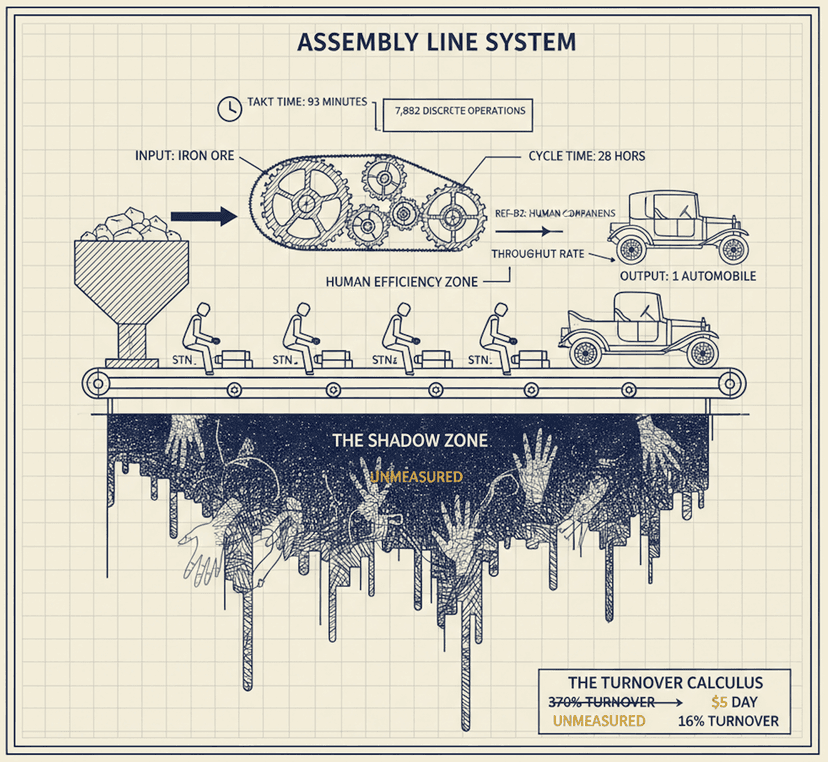
By October 1913, Ford's engineers had extended the magneto experiment to the entire chassis assembly. A car that previously took twelve hours and twenty-eight minutes to assemble now took five hours and fifty minutes. By January 1914, it took one hour and thirty-three minutes. By April 1914, three parallel chassis lines were producing more than 1,200 units in an eight-hour shift. Model T assembly was eventually divided into 7,882 distinct operations.[3]
Clarence Avery, one of Ford's production engineers, calculated that the average worker at Highland Park walked 250 feet during an entire shift in 1914. Before the moving line, workers in automobile plants walked as much as four miles daily. Ford's real achievement was rendering human movement almost unnecessary. The work came to the worker. The worker stayed put.
Between 1908 and 1916, Ford reduced the labor time for a Model T from 12.5 hours to 93 minutes. He cut the price from $850 to $360. Production rose from 10,000 cars per year to 730,000. By 1921, Ford Motor Company was producing more than half of all automobiles sold in America.
The moving line was also a maiming line. Highland Park in 1914 was a place where workers lost an average of sixteen fingers per month on punch presses alone. Fred Colvin, a journalist who toured the plant that year, documented the toll: metal shavings embedded in skin, chemical burns from the paint shop, hernias from lifting, repetitive strain injuries that doctors didn't yet have names for. The transcontinental railroad had killed approximately 1,200 workers. The Panama Canal cost over 5,600 lives. But those projects ended. Highland Park's toll renewed itself every shift, every week, every year. The extraordinary thing about industrial injury is its banality. Nobody writes elegies for the sixteen fingers lost in January. They just hire the next man in line.
Turnover was catastrophic. In 1913, Ford hired 52,000 workers to maintain a workforce of 13,000, a turnover rate of 370 percent. Men walked off the line mid-shift without a word, or they simply stopped showing up for the next day's work. Ford had built the most productive factory in human history and could not keep it staffed.
The assembly line's most important heir was also its most systematic critic. In 1950, a young Japanese engineer named Taiichi Ohno stood on the floor of a Toyota plant and asked a question that Ford's engineers had never considered: What if the worker could stop the line?
Toyota's Andon cord was a rope running the length of the assembly line that any worker could pull to halt production. At some Toyota plants, workers stop the line 2,000 to 4,000 times per day, each stop averaging under sixty seconds. Ford believed the worker was a component whose judgment couldn't be trusted. Toyota believed the worker was a sensor whose judgment was essential. Ford's line ran faster. Toyota's line ran better. By the 1980s, Toyota was building cars with a third of the defects and half the labor hours of comparable American plants.
(Reader, ask yourself: in your organization, who can stop the line? If the answer is "only management," you are running Ford's system, with Ford's blind spots, and Toyota figured out the fix seventy years ago.)
Claude Shannon would have recognized the difference immediately. In 1948, Shannon published the paper that founded information theory, and its central insight was this: a system that cannot receive feedback from its own operations is broadcasting into the void. Ford's line was a broadcast. Management designed, the line executed, workers complied. If a defect entered at station twelve, it propagated through the remaining 7,870 operations and drove away as part of a finished car. Toyota's line was a conversation. The worker detected the defect, pulled the cord, and the correction propagated backward through the system. Shannon and Ohno never knew of each other's work. They arrived at the same architecture from opposite directions, which is usually a sign that the architecture is true.
The Materials
"Failure is simply the opportunity to begin again, this time more intelligently." — Henry Ford
In 1905, at an automobile race outside Paris, Henry Ford witnessed a French car crash at high speed. Most spectators saw destruction. Ford saw opportunity. He walked onto the debris field and picked up a fragment of the wrecked vehicle, a piece of valve stem shaft that seemed impossibly light yet had survived an impact that had demolished the rest of the car.
Ford later described turning the fragment over in his hands, testing its strength, marveling at its properties. "It was very light and very strong," he recalled. "I asked what it was made of. Nobody knew."[1]
The fragment was vanadium steel, an alloy then used primarily in European racing cars and virtually unknown in American manufacturing. In metallurgy, vanadium acts as a grain refiner: it creates a tighter crystalline structure in steel, which increases both tensile strength and resistance to fatigue. For a man obsessed with making cars lighter, stronger, and cheaper, this was the molecular equivalent of finding a cheat code.
Most American steel mills in 1906 could not achieve the 3,000-degree temperatures required to properly alloy vanadium. Ford's solution demonstrated the vertical integration philosophy that would later define his empire: if no supplier existed, he would create one. He sent for J. Kent Smith, an English metallurgical engineer, and funded a small foundry in Canton, Ohio to produce vanadium steel commercially.
C. Harold Wills, Ford's chief designer, immediately grasped the implications for weight reduction and crash survivability. Ford's metallurgists developed proprietary heat-treating methods that tailored vanadium's composition for specific applications: one formulation for axles that needed to absorb shock, another for gears that needed to resist wear, another for crankshafts that needed to survive rotational stress. By 1910, the Model T used more distinct steel formulations than any other car on the market.
Metallurgists have a phrase for what Ford discovered at that Paris racetrack: change the atoms and you change the world. Vanadium rearranged the crystalline structure of steel, and Ford rearranged everything downstream. The Model T was lighter, which meant the engine could be smaller, which meant the car could be cheaper, which meant more Americans could own one, which meant Ford could run the line faster, which meant the price could drop again. One metallurgical insight set off a chain reaction that lasted two decades. Ford understood this at the level of molecules. His genius, and his eventual catastrophe, was the assumption that molecular-level understanding of steel transferred to domains where it didn't: rubber plantations, Brazilian workers, the American consumer's evolving taste.
The Model T's front axle could be cold-twisted eight times without fracturing, a feat that Ford's salesmen demonstrated at county fairs across America. When salesmen performed the same test on competitors' axles, the parts snapped on the second or third twist. Audiences did not need to understand tensile strength to recognize that one car would survive the roads and the other would leave them stranded. This was materials science as sales theater, and it worked because the performance difference was real.
The Model T was famously available in "any color so long as it's black." The restriction was a materials decision with cascading operational consequences. Japan black, a durable asphalt-based enamel, dried faster than any colored alternative available in 1914. Offering multiple colors would have required separate inventory, longer drying times, changeover costs, color-matching training, and scheduling complexity. Ford chose the material that optimized for throughput and eliminated everything else. (A footnote for the historically precise: the earliest Model Ts came in several colors. The all-black restriction arrived in 1914 with the moving line, because the line demanded uniformity.)
Cutting prices is not a sign of weakness; it is a sign of understanding.
Henry Ford
When the Model T launched in 1908, it sold for $850, roughly two years of a factory worker's wages. By 1925, systematic application of what Ford called price-first discipline had reduced the price to $260, approximately three months of wages. A Ford worker earning the $5 Day could purchase a Model T with 52 working days of earnings, whereas the same purchase in 1908 would have required approximately 170 working days.[2]
Consider a number that should embarrass every automotive executive alive today: in 2025, the average new car in America costs approximately $48,000, or eight to nine months of median household income. Ford achieved better affordability a century ago with vanadium steel and Japan black paint than the entire modern industry achieves with robots, CAD software, and global supply chains. Cost reduction does not arrive on its own schedule. It requires someone willing to choose price reduction over margin expansion, and willing to redesign every material, every process, and every assumption to make that choice work. Most operators choose the margin. Ford chose the customer. (You can tell which choice your company has made by asking who gets promoted faster: the person who protects margins or the person who cuts prices. The answer reveals the real strategy, regardless of what the mission statement says.)
Ford's price-first discipline found its most devoted heir in Ingvar Kamprad, the Swedish furniture dealer who founded IKEA. Kamprad called his approach "democratic design": good design should not be reserved for wealthy consumers. IKEA's flat pack transferred labor from factory to customer, eliminating assembly workers, reducing warehouse space, and cutting transportation costs. A 2012 Harvard study found consumers who assembled IKEA products themselves valued them approximately 63 percent more than identical pre-assembled items. The constraint that seemed like deprivation had become a source of value. Ford would have understood. His constraints were never limitations. They were load-bearing walls.
The $5 Day
"It is not the employer who pays the wages. Employers only handle the money. It is the customer who pays the wages." — Henry Ford
George Pullman is buried in a pit lined with concrete, surrounded by railroad ties reinforced with steel, covered by more concrete, and finally topped with an elaborate monument that conceals the fortress beneath. His family feared that workers he had employed would dig him up.
Pullman, Illinois, was the first planned company town in American history. The Palace Car Company provided everything: housing, stores, a library, a church, parks landscaped with imported trees. Workers paid rent that returned their wages to their employer. When the Panic of 1893 collapsed demand, Pullman cut wages by twenty-eight percent without reducing rents. On May 11, 1894, nearly four thousand workers walked out. Eugene V. Debs organized a boycott. Rail traffic stopped in twenty-seven states. President Cleveland sent federal troops. By late July, thirty-four strikers were dead.
The Pullman disaster encoded a lesson in concrete, steel, and blood: control workers' lives through ownership, and you trap them; trap them, and eventually they explode. Ford read the lesson. Then he built his own version anyway.
The chain system you have is a slave driver! My God! Mr. Ford. My husband has come home and thrown himself down and won't eat his supper... so done out!
Letter from a Ford worker's wife, January 23, 1914
By late 1913, Ford Motor Company's Highland Park plant had become the most productive industrial facility in human history and also one of the most difficult places in America to retain employees. The moving assembly line had reduced Model T assembly time from twelve and a half hours to ninety-three minutes. But the system also made the work miserable in ways that previous factory jobs had not been. Ford kept the letter above in his files. He understood the complaint.
On New Year's Day 1914, Ford and his executives gathered to address the turnover crisis. James Couzens was present. Ford wrote the existing minimum pay of $2.34 on a blackboard and instructed his executives to figure out how much more the company could give. The meeting reportedly progressed through $3.00, then $3.50, then $4.80. Every so often Ford walked in, said "Not enough," and walked out. Finally, someone snapped: "Why don't you make it $5 a day and bust the company right?" Couzens, whose instinct for publicity matched Ford's instinct for production, argued that a $5 wage would generate more publicity than any advertising campaign Ford could buy.
On January 5, 1914, Couzens announced the $5 Day. It more than doubled the prevailing wage. The Wall Street Journal condemned Ford for applying "Biblical or spiritual principles" where they did not belong. The paper's editorial board could not see what Ford saw: the $5 Day was an investment in system stability, and it would pay for itself within months.
One week after the announcement, ten thousand men surrounded Highland Park. By noon, fifteen thousand. Ford's security forces turned fire hoses on the crowd in January temperatures. The men did not leave. They found dry clothes, or they did not, and came back. The wages were high enough that men would endure being attacked for the chance to earn them.
Ford's turnover rate collapsed from 370 percent to approximately 16 percent within months. The productivity gains from stable labor more than offset the increased wage costs.[1] The economic logic was brutal and clear: training a new worker cost Ford approximately $70 at a time when the daily wage was $2.34. If turnover fell by fifty percent, the savings in training costs alone would fund most of the wage increase. Ford had solved the human problem with an engineering solution: if the system breaks the worker, pay the worker enough to stay anyway.
But the $5 was not a wage increase. It was a profit-sharing arrangement: $2.34 in wages plus $2.66 in conditional payments. The conditions were where Ford's engineering instinct turned into something darker. He created the Sociological Department, a team that eventually grew to two hundred investigators who functioned as Ford Motor Company's domestic surveillance operation. They made unannounced visits to workers' homes, arriving in Ford automobiles with interpreters and clipboards. Did the worker rent or own? How much had he saved? Was the home clean? Was the diet adequate? Were there boarders, an evil practice the department was ordered to discourage? Were the children in school? Was the wife working outside the home (grounds for losing the profit-sharing payment)?
Workers who passed received the full $5. Workers who failed were placed on probation: six months to reform, or face termination. The department also established the Ford English School, where immigrant workers graduated through a ceremony involving a giant prop cauldron labeled "The Melting Pot." They descended wearing native clothing and emerged wearing identical American suits, waving American flags. Samuel Marquis, the Episcopalian minister Ford hired to run the department, reported that attendance was compulsory, and a worker who hesitated was "laid off and given a chance for uninterrupted meditation and reconsideration."
The dark comedy of the Sociological Department is that Ford believed, with perfect sincerity, that he was helping. He was not cynical about the home inspections any more than a Victorian missionary was cynical about converting pagans. The colonial empires ran on identical logic: genuine benevolence married to structural coercion, held together by the absolute conviction that the civilizer knows best. Ford wanted clean homes, sober workers, stable families, and English-speaking citizens. He got them. The cost was a surveillance apparatus that would have made J. Edgar Hoover envious, had Hoover not been busy building his own.
Milton Hershey discovered that amenities without adequate wages produced the same instability. In 1937, when Hershey cut bonuses during the Depression, his workers struck. Farmers joined company loyalists to storm the factory and beat strikers with fists, clubs, and ice picks. Pullman, Ford, Hershey: the pattern is thermodynamic. You cannot compress a labor force without generating heat. The only question is whether the container holds.
The company town never disappeared; it evolved. In May 2025, residents of Boca Chica, Texas, voted to incorporate as Starbase, headquarters of SpaceX. The vote was 212 to 6. Nearly all residents were SpaceX employees. The structural difference from Pullman is equity: SpaceX employees own shares in a company valued at over $200 billion. They are attracted by compensation packages that align their interests with company success. Pullman's workers paid rent. Starbase's workers own stock. The architecture looks similar from the outside. The incentive physics are inverted.
Amazon's fulfillment centers track worker behavior through Time Off Task, logging any period when a worker is not actively scanning packages. The structure is Ford's: wages high enough to make the job attractive, surveillance comprehensive enough to ensure compliance. The Sociological Department would recognize the system immediately. Only the technology has changed.
The Model T Trap
"The old master had failed to master change." — Alfred P. Sloan
In 1923, Ford Motor Company sold 2.1 million Model Ts, the highest annual total in the car's history. Henry Ford controlled more than half the American automobile market. To any observer examining the sales figures, the question was not whether Ford's dominance would continue, but whether anyone could ever challenge it.
Alfred P. Sloan could. The new president of General Motors understood something about the American consumer that Ford either could not see or refused to acknowledge: the Model T was an ideal first car. But for the second car, the third car, the car that said something about who you had become, customers wanted choice. They wanted color. They wanted style that changed with the seasons. They wanted to buy on credit rather than save until they could pay cash.
Sloan's strategy was elegant and completely alien to Ford's worldview. Instead of one product for everyone, GM would offer "a car for every purse and purpose." Chevrolet at the bottom, Cadillac at the top, Buick and Oldsmobile and Pontiac filling the spaces between. Annual model changes would make last year's car look dated, creating a perpetual upgrade cycle that turned automobiles from durable goods into fashion items. Installment purchases would allow customers to buy today and pay tomorrow.
Ford despised every element of this approach. He refused installment purchasing on principle: a man should save for what he wanted, not borrow. He refused annual model changes: the Model T worked, and changing it would disrupt production. He refused color options: Japan black dried fastest, and that was that. In Ford's mind, these were moral positions, not business decisions. Thrift was a virtue. Debt was weakness. Consistency was integrity. The man who had reinvented manufacturing could not see that the market he had created was evolving past the product that created it.
The numbers tell the story of a collapse so gradual that Ford could rationalize each year's decline as a temporary fluctuation. Sales peaked at 2.1 million in 1923. They held at 1.9 million in 1924 and 1925. They dropped to 1.5 million in 1926, the year Ford finally agreed to minor cosmetic updates: lowered bodies, nickel radiator shells on closed models, and, reluctantly, some colors. The updates looked like warmed-over copies of the Chevrolet designs of 1923. By the time Ford caught up, Chevrolet had moved on.
In 1927, the final year, Model T sales collapsed to less than 500,000. Chevrolet sold more than 650,000 Capitol-series cars and took the number one spot in American auto sales for the first time. Ford shut down every factory, laid off 60,000 workers, and closed production entirely for nearly six months while his engineers designed the Model A. The man who had revolutionized continuous production stopped producing altogether. It was the operational equivalent of a heart attack.
William Knudsen, the former Ford production wizard whom Ford had fired for having too many ideas, was now running Chevrolet. The man Ford couldn't tolerate was building the cars Ford couldn't compete with. Knudsen understood both Ford's system and its limitations, which made him the most dangerous competitor imaginable: an apostate who knew where the cathedral's load-bearing walls were weakest.
The Model A, when it finally arrived in December 1927, was a sensation. Ten million Americans saw it within the first thirty-six hours. At Madison Square Garden, 1.25 million people filed through in five days. It went 65 miles per hour, came in four colors, and offered seventeen body styles. Ford even allowed installment purchasing. He had adopted, under duress, every element of Sloan's strategy that he had spent a decade condemning. Within six months, Ford sold two million Model As.
But Chevrolet introduced its six-cylinder engine in 1929, and by 1931, GM had retaken the lead. Ford never permanently recovered the market dominance he had held in 1921. The company that once produced more than half of all American cars would spend the next century fighting for second or third place.
The paradox is worth holding in your hands for a moment, because it will cut you. Ford was not wrong about the Model T. For twenty years, his single-product strategy produced results that no competitor could match. Lower prices, higher volumes, greater market share, fatter margins. The strategy succeeded so completely that it created the conditions for its own destruction. By putting fifteen million Americans behind the wheel, Ford created a customer base sophisticated enough to want something he refused to provide. The assembly line that made the Model T affordable also made Chevrolet affordable. Ford had democratized the automobile, and the democracy voted for variety.
If you are running a company right now, and your core product is winning, and your instinct is to double down on the thing that's working: you are Ford in 1923. Two million units. Fifty percent market share. Four years from irrelevance.
In game theory, this pattern has a name: the winner's curse. The party that wins the auction often overpays, because winning requires the highest bid, which is usually above the asset's actual value. Ford won the automobile market so completely that he could not imagine losing it. His success became his prison.
Vertical Integration
"Whether you think you can, or you think you can't — you're right." — Henry Ford
In December 1930, in a cafeteria carved from the Brazilian jungle, a worker stood and refused to line up for his food. The cafeteria had just switched to self-service, an American efficiency that required workers to queue with trays. "We are not dogs," he shouted, "that are going to be ordered by the company to eat in this way."
The room exploded. Workers smashed dishes, overturned tables. They poured out of the cafeteria and attacked everything. Time clocks were torn from walls. Workers sank company vehicles in the Rio Tapajós while shouting "Brazil for Brazilians, murder all Americans!" When author Greg Grandin later asked what Fordlandia was like, he answered with a comparison: "Think more of Deadwood than Our Town."[5]
The company that built this cafeteria had also built the largest manufacturing complex in human history, where iron ore arrived by ship and emerged as finished automobiles twenty-eight hours later. The man who owned both believed the principles governing one should govern the other. He was half right, which in the Amazon turned out to be completely wrong.
Ronald Coase formalized the logic in 1937: firms grow by bringing transactions inside when internal coordination costs fall below market transaction costs. Ford never read Coase, but he had arrived at the same principle through instinct and distrust. Sorensen later wrote that Ford "feared that outsiders would cheat him, would let him down, would fail to meet his standards."[4] The River Rouge was a fortress built by a man who believed he could trust only what he owned.
Ford began purchasing land near the mouth of the Rouge River in 1915. He had even considered turning the site into a bird sanctuary. Construction began in 1917, and in a sense never stopped during Ford's lifetime. By 1928, the Rouge complex sprawled across two thousand acres, ninety-three buildings containing sixteen million square feet, connected by one hundred miles of interior railroad track and twenty-seven miles of conveyors. Albert Kahn designed the buildings as machines rather than containers. At its peak, more than one hundred thousand workers punched in daily. A journalist captured the promise: at eight o'clock, iron ore arrived from Ford mines. Twenty-eight hours later, the metal drove away as part of a finished automobile. Ford also owned 700,000 acres of forest, iron mines and limestone quarries across Michigan, Minnesota, and Wisconsin. The Rouge had its own blast furnace, steel mill, glass plant, cement plant, and a power station that could have electrified Detroit.
The Rouge worked because Ford understood every transformation happening inside it. He had spent decades learning how steel behaved, how glass formed, how rubber cured, how paint dried. The Rouge was the physical expression of accumulated operational knowledge, decades of learning translated into steel and glass and concrete.
Fordlandia was a bet on a principle. Having succeeded beyond imagination at the Rouge, Ford decided to extend vertical integration further. He would grow his own rubber. The rubber tree, Hevea brasiliensis, originated in the Amazon but had been transplanted to Southeast Asia, where it flourished in plantation settings. Ford acquired 2.5 million acres along the Rio Tapajós. He never consulted a single expert on tropical agriculture. He sent managers from Michigan, imposed American customs: a nine-to-five schedule, mandatory American food (brown rice, whole-wheat bread, canned peaches), prohibition of alcohol, required attendance at square dances. He built a hospital, a golf course, clapboard houses, fire hydrants.
What Ford did not understand was Microcyclus ulei, the South American leaf blight, a fungal disease that had evolved alongside the rubber tree for millions of years. In the wild, rubber trees grow scattered, rarely touching, which prevents the fungus from spreading. This dispersal pattern is the product of an evolutionary arms race between tree and pathogen that has lasted longer than human civilization. Ford's plantation packed trees together in neat rows, the way plantations worked in Southeast Asia, where the fungus did not exist. In the Amazon, the blight spread from tree to tree like fire through dry grass. By 1935, when the first mass plantings matured, caterpillars and leaf blight had killed or damaged the majority of trees.
Not one drop of latex from Fordlandia ever made it into a Ford car.
Ford's grandson Henry Ford II sold both Fordlandia and its replacement plantation at Belterra to the Brazilian government in 1945 for $244,200, the amount the company owed its workers as severance pay. The total loss was approximately $20 million, equivalent to roughly $358 million in 2025 dollars.[5]
The biological metaphor is precise. In ecology, monocultures are efficient but fragile. A wheat field produces more calories per acre than a forest but dies when a single pathogen finds it. A diverse forest produces less per species but survives what the monoculture cannot. Ford built monocultures: of cars, of processes, of social arrangements. They were spectacularly productive until the environment changed, and then they were spectacularly brittle.
Carnegie integrated coal and iron because he had spent decades learning how both industries worked. Ford integrated rubber because he believed his principles were universal. The Rouge proved that integration works when the operator understands every transformation happening inside the system. Fordlandia proved what happens when he doesn't.
The 1919 lawsuit from the Dodge Brothers laid bare the structural tension in Ford's approach. John and Horace Dodge, who owned ten percent of Ford Motor Company, sued when Ford stopped paying special dividends to fund the Rouge expansion and wage increases. Ford told the court his ambition was "to employ still more men, to spread the benefits of this industrial system to the greatest possible number." The Michigan Supreme Court was unmoved. "A business corporation is organized and carried on primarily for the profit of the stockholders," the justices wrote. Ford was ordered to pay dividends. The ruling, Dodge v. Ford Motor Co. (1919), became the legal foundation for shareholder primacy in American corporate law, and it was directly provoked by Ford's insistence that vertical integration served humanity, not just the balance sheet.
Ford responded with characteristic stubbornness. He threatened to quit and start a new company. The Dodge brothers, fearing that Ford's departure would collapse their investment's value, sold their shares. Ford bought out every minority shareholder, making Ford Motor Company a family-controlled entity answerable to nobody. The integration could proceed unchecked. Fordlandia was one of the results.
Toyota took a different path: quasi-integration through long-term relationships with independent suppliers who located near plants and shared quality data. Toyota could adjust specifications without bearing the capital costs of ownership. The Toyota model is what network theorists call a loosely coupled system: components are connected but can fail independently without cascading.
Leonardo Del Vecchio, born too poor to keep, placed in an orphanage at seven, began manufacturing eyeglass frames in 1961 under the name Luxottica. By 2018, when Luxottica merged with Essilor, the combined entity controlled nearly everything in eyewear: manufacturing, retail, even vision insurance. Del Vecchio succeeded because he learned every link in the chain over fifty-seven years before owning it. Ferrero, the chocolate company, waited until 2014 to acquire Turkey's largest hazelnut processor, after decades of learning the domain. Delta Air Lines purchased an oil refinery in 2012, and skeptics multiplied. But Delta was solving a specific problem, jet fuel pricing, in a domain adjacent enough to master.
SpaceX manufactures approximately eighty-five percent of Falcon rocket components in-house. Raw materials enter Hawthorne; complete rockets emerge. But SpaceX integrates selectively, maintaining over three thousand suppliers for standardized components. The selection criterion is iteration speed: if SpaceX can redesign a turbopump on Tuesday and test it Thursday, a supplier's six-week lead time becomes an unacceptable bottleneck. SpaceX owns what it needs to iterate on. It buys what it doesn't.
The temptation never dies. Every operator who has built something that works feels the gravitational pull toward owning more, controlling more, bringing the next process inside the walls. The pull is rational. The danger is that it feels like principle when it is actually appetite. Ford felt the pull from Highland Park to the Rouge to the Amazon. The first move was genius. The second was defensible. The third was hubris wearing a pith helmet, planting rubber trees in rows that evolution had spent millennia learning to scatter.
The Rigidity Trap
"It is difficult to get a man to understand something when his salary depends on his not understanding it." — Upton Sinclair
In December 1975, a twenty-four-year-old engineer named Steve Sasson walked into a conference room at Eastman Kodak carrying a device the size of a toaster. He had built it from scraps: a lens salvaged from a Super 8 camera, sixteen nickel-cadmium batteries, several dozen circuits. The contraption took twenty-three seconds to capture a single image.
Sasson pointed the device at the executives. When the image appeared, grainy and black-and-white, one hundred pixels by one hundred pixels, the men who ran the world's dominant photography company saw the future of their industry.
They asked how long before this matched film quality. Sasson calculated: fifteen to twenty years. They told him the technology was cute, but he should not tell anyone about it.
Kodak patented Sasson's invention and buried it. In 2012, Eastman Kodak filed for bankruptcy. Sasson received the National Medal of Technology from President Obama.
The executives were not stupid. By 1975, Kodak controlled roughly ninety percent of the American film market. Kodak was selling memory: the irreplaceable christening, the unrepeatable wedding, the child who would never be that small again. The emotional stakes of photography created demand that mere utility could never match. The executives understood what digital photography meant for that model. If photographs existed as electronic files, there would be no film to sell. A technology that eliminated film was not an opportunity; it was an immune response from the future.
Clayton Christensen called this the "innovator's dilemma": the practices that make companies successful in established markets make them vulnerable to innovations that initially appear inferior.[6] But Christensen's framework is often simplified into a story about blindness. The executives at Kodak were not blind. They saw exactly what digital photography would do. Their problem was structural, not perceptual: every rational incentive in the organization pointed toward protecting film revenue. The salesforce earned commissions on film. The factories were tooled for film. The chemists had spent careers perfecting film. To pivot to digital would have meant firing the people who made the company great in order to hire people who might make it great again. The word for that, in organizational behavior, is not strategy. It is betrayal.
In September 2000, Reed Hastings and Marc Randolph flew to Dallas to meet John Antioco, CEO of Blockbuster. Their company, Netflix, was losing money. Blockbuster had nine thousand stores, five billion dollars in revenue. Late fees generated over eight hundred million annually.
Hastings made his pitch: Blockbuster would acquire Netflix for fifty million dollars. Netflix would run the online business; Blockbuster would keep the stores. Randolph watched Antioco's face. "I saw something new," he later wrote, "his earnest expression slightly unbalanced by a turning up at the corner of his mouth." Antioco was struggling not to laugh.[7]
Antioco declined. But give the man credit: four years later, he launched Blockbuster's online service. In 2005, he eliminated late fees entirely, accepting a loss of six hundred million dollars. Netflix's stock fell forty percent. Antioco was fighting, and for a moment, winning.
What killed Blockbuster was not blindness but captivity. The board, pressured by activist investor Carl Icahn, demanded immediate profitability. In March 2007, they forced Antioco out and replaced him with a CEO who reinstated late fees and gutted the online operation. Three years later, Blockbuster filed for bankruptcy. Netflix, which Blockbuster could have owned for fifty million dollars, is now worth more than two hundred billion.
The Blockbuster story reveals something that Christensen's framework captures but that most summaries omit: the innovator's dilemma is often resolved in the boardroom, not the market. Antioco saw the threat and responded. His board, governed by quarterly earnings expectations and an activist investor's short-term calculus, undid the response. The immune system that killed Blockbuster was financial, not technological.
Ford himself was the original case study. By 1925, the Model T was losing ground to Chevrolet, and everyone at Ford Motor Company could see it except the man whose name was on the building. His engineers begged him to update the car. His dealers sent frantic letters. His son Edsel, who had been given the title of president, argued for change and was overruled so consistently that the title became decorative. Sloan later wrote the epitaph: "The old master had failed to master change."[8]
Ford's rigidity with the Model T and Kodak's burial of the digital camera share the same deep structure. In both cases, the dominant product had become inseparable from the organization's identity. Ford was not a car company that made the Model T. Ford was the Model T. Kodak was not a company that sold film. Kodak was film. When the product is the identity, improving the product feels like growth, but replacing it feels like death. And organizations, like organisms, will do almost anything to avoid death, including dying slowly rather than risking transformation.
Is escape possible? The evidence says rarely, and only under specific conditions. IBM transitioned from mainframes to services, but only after a near-death experience in 1993 that gave Lou Gerstner license to gut sacred cows. Apple reinvented itself three times, but Steve Jobs had founded the company, had been away long enough to see the rot clearly, and possessed a willingness to destroy existing product lines that bordered on pathological. Netflix disrupted Blockbuster, then disrupted itself by abandoning DVDs for streaming, then again by producing original content. Reed Hastings described the discipline this way: you have to be willing to obsolete your own product before someone else does. That willingness has to be trained, like a muscle that most organizations never exercise.
The survivors share characteristics. They are led by people who can see their companies from outside. They have cultures that reward bad news over comfortable silence. They have ownership structures that permit long-term investment over quarterly performance. And they have what might be called strategic humility: the awareness that the practices that built the fortress may not defend it.
Ford lacked every one of these. He could not see the company from outside because the company was an extension of his ego. He punished bad news, firing executives who disagreed with him and physically intimidating his own son. His ownership structure, after the Dodge Brothers buyout, permitted whatever he wished, which turned out to be the problem. And strategic humility was incompatible with the identity of a man who had remade the world and assumed the world would stay remade.
The Operator's Playbook
You will find the standard version of Ford's lessons in every operations management textbook and every airport bookstore. Standardize your processes. Reduce waste. Integrate your supply chain. Pay your people well. This advice is correct in the way that telling a drowning man to swim is correct. It describes the desired outcome and says nothing about the current pulling him under. The operators who actually built and lost empires of Ford's scale faced problems that swim-harder advice cannot reach, because the problems were structural: baked into the system's own success, invisible to the people inside it, and resistant to the individual-level tools that every consultant prescribes. Self-awareness, strategic thinking, good judgment: these are the interventions that already failed. The following three practices are derived from operators who broke through anyway, and each one addresses a specific failure mode that occurs precisely when self-awareness and strategic thinking are at their peak.
The Sorensen Speed Test. Picture Sorensen on April 1, 1913, with his stopwatch and his twenty-nine men and his rope-dragged flywheels. He did not begin with a theory about optimal line speed. He did not convene a strategy offsite. He tested three speeds, measured the output, and let the data choose. The middle speed won, and the discovery contradicted every prior assumption about faster-is-better. This is the practice, and it is more radical than it sounds: before committing to any operational change, build the cheapest possible version and test it at three different intensities. Three, not two. Two options create a binary that confirms the bias you walked in with. Three options reveal a curve, and curves contain information that binaries destroy. Sorensen's Speed Test applies to pricing (three price points, not the two your finance team proposed), to hiring (three team structures, not the one the VP already approved), to product launches (three feature sets, not the one engineering fell in love with six months ago). When was the last time your organization tested three versions of a critical decision before committing? If you are sitting in a company that spends millions on decisions validated by a single pilot program, you are running on assumption where Sorensen ran on evidence. His rope-and-pulley experiment looked laughable. It produced the most productive factory in human history. Most organizations skip the test because testing implies uncertainty, and uncertainty feels like weakness to people whose careers depend on projecting confidence. Sorensen's genius was treating uncertainty as data.
The Fordlandia Audit. Ford's jungle disaster is usually told as a story about arrogance: rich man assumes his principles are universal, jungle teaches him otherwise. The story is accurate and insufficient. The deeper failure was epistemological. Ford assumed that principles which worked in one domain (automobile manufacturing in Detroit) would transfer to another (tropical agriculture in Brazil) the way a mathematical proof transfers across number systems. He packed rubber trees into rows because that's how plantations worked in Southeast Asia, ignoring the millions of years of coevolution between Microcyclus ulei and Hevea brasiliensis that made those rows a fungal superhighway. He never asked a botanist. He never asked a Brazilian. He never asked anyone who might have told him something he didn't want to hear. Before extending any successful system into a new domain, name the three to five assumptions that make your current system work. Write them down. Then find someone who owes you nothing and knows the new domain cold, and ask them to tell you which assumptions hold and which will kill you. The Rouge worked because Ford had spent decades learning steel at the molecular level. Fordlandia failed because Ford believed that mastery of steel conferred mastery of fungal ecology. For each assumption underlying your expansion, can you name the specific evidence, not analogies, not intuitions, not the warm feeling that your principles are universal, that it holds in the new environment? If you cannot, you are Ford in the jungle. And the jungle, as Grandin observed, does not negotiate.
The Sloan Mirror. This is the hardest of the three because it operates at the level of identity, and identity is the one thing operators protect more fiercely than market share. Alfred Sloan did not beat Ford by building a better car. He beat Ford by looking at Ford's own customers and seeing what Ford's identity made invisible: they were ready for something new, and they were buying used Buicks because Ford would not give them a new alternative. The practice: once per quarter, give someone with no emotional investment in your core product a single question to answer: if we were starting this company today, with no legacy assets and no existing customers, would we build what we are currently building? If the answer is no, the follow-up is not "how do we fix it," which leads to incremental adjustments that preserve the existing identity. The follow-up is "what would we build instead?", which forces confrontation with the gap between who you are and what the market needs. Ford's Model T trap sprang because nobody at Ford Motor Company could survive asking this question out loud. Edsel tried and was overruled. Knudsen tried and was fired. When the most competent people in your organization cannot tell you the truth about your core product without risking their careers, you have built Ford Motor Company in 1925. Sloan could hold the mirror because General Motors was not an extension of his ego. Ford could not look because the Model T was not a product to him. It was a confession of faith, and you do not optimize a confession of faith. You defend it until the market buries you. The question every operator needs to answer, and the one most will avoid: who in your organization has both the standing and the safety to say the words "this is obsolete"? Name the person. If you cannot, the Sloan Mirror has already shown you what it shows.
The Last Line
On May 26, 1927, Henry Ford and his son Edsel drove the fifteen millionth Model T off the assembly line at Highland Park. It was the last one. The factories went dark. Sixty thousand workers went home without knowing when, or whether, they would return.
Ford was sixty-three years old. He had put the world on wheels, doubled the industrial wage, built the largest factory complex in history, and created a car that fifteen million Americans had purchased. He had also held that car in production for six years past its expiration date, built a surveillance department to police his workers' dinner plates, funded a newspaper that published antisemitic conspiracy theories for seven years, and sunk twenty million dollars into a jungle that ate his rubber trees and sent him home with nothing.
This volume has argued that Ford's system created both unprecedented productivity and unprecedented rigidity. The honest version of that thesis is uglier: Ford's system created unprecedented productivity through unprecedented rigidity. The stubbornness that held the Model T at $260 was the same stubbornness that held the Model T at $260 when the market wanted something else. The control that built the Rouge was the control that planted rubber trees in rows. The confidence that doubled the wage was the confidence that sent investigators into kitchens. You cannot separate the genius from the pathology when the genius is the pathology operating in a favorable environment.
Sit with that, if you are an operator who has built something that works. If your professional identity has been validated by extraordinary results, you are Ford. Your system is producing. Your market share is growing. Your instincts have been right for years. The question this volume cannot answer, because Ford's own life proves it may be unanswerable, is whether you will recognize the moment when the environment shifts and your greatest strength becomes the thing that buries you.
The last Model T rolled off the line on a Tuesday. Ford watched it go. He had won so completely that the world changed around him, and he was the last one to notice.
That is the most expensive kind of victory there is.