
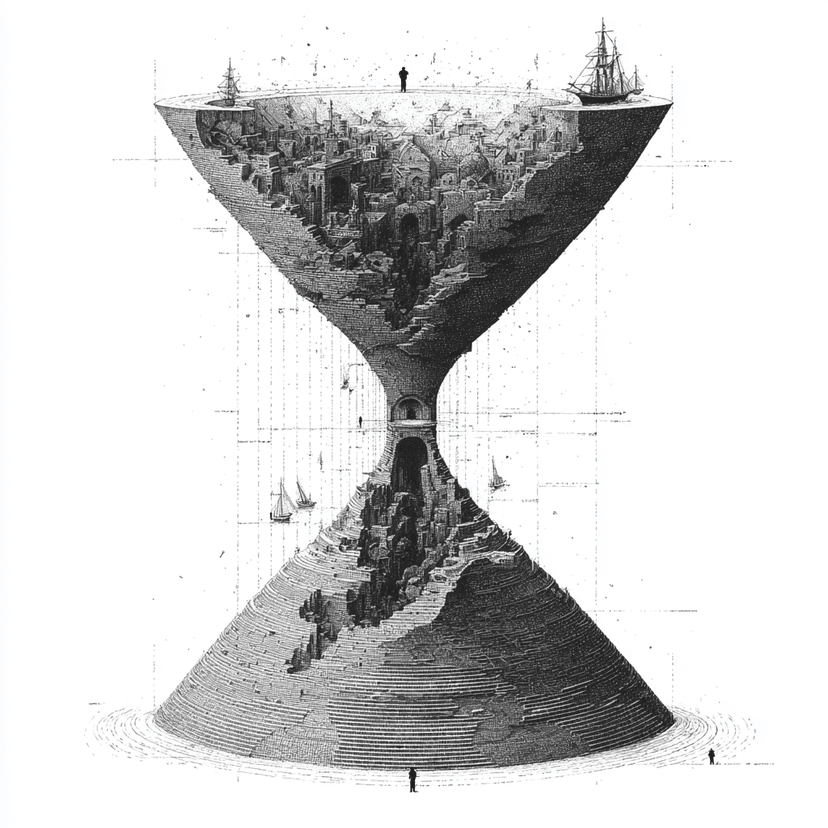
Three hundred against three hundred thousand. The ratio is absurd. Zack Snyder built an entire franchise around making it look cool, slow-motion spears, oiled abs, Gerard Butler screaming into a pit. But the ratio is the least interesting part of Thermopylae. What Snyder’s camera never lingers on, because it is not cinematic, is the width of the pass.
The coastal corridor at Thermopylae, where the mountains met the sea in 480 BC, could hold only a few dozen men abreast. Leonidas chose it for precisely this reason. The Persian army’s numerical advantage, the very thing that made it terrifying in open terrain, became geometrically irrelevant at this single point. Three hundred Spartans, rotating in and out of the front line, held the pass for three days. Not because they were stronger than the Persians. Because they were positioned where strength didn’t matter.
The Persians eventually found a goat path around the mountains. Leonidas died. Greece survived anyway, because those three days bought time for the naval victory at Salamis. But the lesson that survived longer than any of the combatants is one that has been independently rediscovered by Arab nomads, Venetian merchants, Cleveland oil men, Taiwanese engineers, and a programmer in a Madison, Wisconsin basement: whoever controls the bottleneck controls the system. The size of the armies on either side is a secondary concern.
Twenty-three centuries after Thermopylae, in Cleveland, Ohio, a bookkeeper’s son named John D. Rockefeller identified his own narrow pass and used it to build the most profitable enterprise in American history. A century after Rockefeller, a twenty-six-year-old programmer named Judy Faulkner identified another one and used it to accumulate more control over American healthcare data than the federal government. The principle connecting a Spartan king, an oil baron, and a software engineer is not metaphorical. It is structural. And the structure is unstable in ways its beneficiaries prefer not to examine.
The same concentration that creates extraordinary power creates extraordinary fragility. Every chokepoint operator in history has eventually discovered that controlling the narrow pass makes you the most important person in the system and the most obvious target. The Nabataeans controlled desert water for centuries, then Rome showed up with legions. Rockefeller controlled petroleum refining for decades, then Ida Tarbell showed up with a typewriter. The doctrine builds empires. It also builds the conditions for their destruction. Chokepoint control works. That part is settled. Whether anyone has ever solved the problem of surviving their own success at it is not.
Water in the Desert
Before Standard Oil, before railroads, before the concept of a corporation existed in any form a modern person would recognize, the principle was already ancient.
The Nabataeans were a nomadic Arab people who settled in the arid lands between the Red Sea and the Dead Sea around the sixth century BC. They had no army worth mentioning. They produced nothing of commercial value. They occupied territory so hostile that invading armies avoided it on principle. And they became spectacularly, almost absurdly wealthy, for a reason so simple it reads like a parable.
Their homeland sat astride the incense trade route connecting the Arabian Peninsula to the Mediterranean world. Frankincense and myrrh, commodities that ancient civilizations valued on a level modern economies reserve for petroleum, had to cross this desert to reach their markets. Crossing this desert required water. The Nabataeans controlled the water. They had spent generations mapping secret cisterns and underground reservoirs throughout the Negev, knowledge they guarded with lethal seriousness. A caravan attempting the crossing without Nabataean cooperation would die of thirst. No alternative route existed. No technological workaround was available. You paid the Nabataeans or your camels dropped and your merchandise rotted in the sand.
The toll was a full quarter of all goods in transit. The Nabataeans owned no frankincense, manufactured none, sold none to end consumers. They controlled the stage through which it flowed, and that control entitled them to 25% of its value.[1] Visa and Mastercard, the modern world’s closest analogues to a pure infrastructure toll, charge roughly 2-3% on payment volume. The Nabataeans charged ten times that. Nobody complained. The alternative was death.
Every fintech founder on Sand Hill Road pitching a “disruptive payments platform” should be required to study the Nabataeans before their Series A. The playbook has not changed in 2,600 years. The only thing that’s changed is that modern toll collectors have to pretend they’re providing a service.
The water mattered less for what it provided than for what it prevented. They destroyed competing water sources. They kept cistern locations secret on pain of death. They cultivated relationships with neighboring tribes that ensured no one would guide caravans on alternate paths. The bottleneck’s value was a function of one variable: the number of alternatives available to the people passing through it. A bottleneck with ten substitutes is a nuisance. A bottleneck with zero substitutes is a license to set any price the traffic will bear. Every chokepoint operator in recorded history has spent at least as much energy eliminating alternatives as maintaining the infrastructure itself.
Karl Wittfogel, the historian who coined the term “hydraulic empire,” identified the same pattern in Mesopotamian canal systems. Rulers who controlled water allocation determined which farmers prospered and which starved. Food production depended entirely on decisions made at the point of distribution. Wittfogel was writing about Sumerian kings. He could have been writing about any of the operators in this volume. The resource changes. The geometry does not.
Ancient oases operated the same way across the Sahara. Where underground water reached the surface, tiny settlements became mandatory stops for every caravan crossing the desert. Military control of an oasis meant control over the trade route and its wealth. The volume of gold or salt a trader carried was irrelevant. If the oasis denied him water, he was finished. Substitute the oasis for a cloud computing region, a payment rail, a fiber-optic landing station, a deep-water port. The resource is different. The math is the same.
The Nabataean system lasted centuries. Then Rome annexed their territory in 106 AD, and the fundamental vulnerability of the model revealed itself. The Nabataeans had built their power on a chokepoint controlled by consent: caravans used their route because alternatives were worse. Rome did not need to find an alternative route. It brought enough soldiers to take the existing one. The most profitable position in the ancient world became the most conquered one, because centuries of toll collection had advertised exactly how much wealth was sitting there, undefended by anything except geography and reputation.
The pattern will repeat. The admirers of chokepoint strategy prefer not to discuss it.
The Rockefeller Method
When Rockefeller first visited the oil regions at Titusville, Pennsylvania, in the early 1860s, he saw what every visitor saw: chaos. Wells blew in without warning. Crude prices swung from twelve dollars a barrel to ten cents. Fortunes materialized and evaporated within the same season. Teamsters fought over rutted roads. Derricks stood so close together that a fire in one field could destroy a dozen operations in an hour.
Where other observers concluded that the chaos made the industry unattractive, Rockefeller drew a more precise conclusion. The chaos was concentrated upstream, in production, where thousands of independent operators made individually rational decisions that collectively destroyed everyone’s margins. The chaos was absent downstream, in the consumer market, where demand for kerosene was growing steadily as American households replaced candles and whale oil with the cheaper, brighter alternative. Between the chaotic upstream and the stable downstream sat a single stage that every barrel of crude had to pass through on its way to market: refining.
John T. Flynn, writing in God’s Gold, captured the moment. Rockefeller surveyed the situation and “quickly saw that this oil business divided itself into three departments: producing, refining, and transportation.” Crude cost between two and twelve dollars a barrel. Refining cost thirty cents. The margins were enormous, but it was the producing end whose disorder “shocked” the young man from Cleveland.[2]
Rockefeller looked at the oil regions the way a structural engineer looks at a building with a cracked foundation. The problem was obvious. The solution was architectural. And the person who implemented it would capture the value that the disorder was currently destroying. His approach was sequential: consolidate Cleveland’s refineries to gain dominant capacity, then use that capacity to negotiate preferential railroad rates (the railroads needed Standard Oil’s guaranteed volume more than Standard Oil needed any individual railroad), then use the cost advantage from preferential rates to undercut remaining competitors, then offer those competitors a choice between joining Standard Oil on its terms and competing against a company with structural cost advantages they could never match.
Henry Flagler, Rockefeller’s closest partner, went to the Lake Shore Railroad with a proposition: Standard Oil would guarantee sixty carloads of oil per day, every day, and assume all risk of fire and load and unload its own oil. In exchange, Standard Oil wanted a rate of 35 cents per barrel for crude and $1.30 for refined oil to New York. The railroad’s normal rate was far higher, but Flagler’s guarantee solved a problem the railroad cared about more than price: utilization. Empty freight cars, unpredictable volumes, the cost of managing hundreds of small shippers.[2] The guarantee reduced round-trip time from thirty days to ten, effectively tripling the railroad’s capacity on the Cleveland route.[3]
The freight concession looked like favoritism. It was arithmetic. A customer who eliminated variance, guaranteed volume, and absorbed risk earned a rate reflecting the railroad’s actual costs of serving that customer. And the rate destroyed competitors. A refiner shipping five carloads a week could not offer the railroad the same volume guarantee, the same loading precision, the same risk absorption. The cost gap widened not because Rockefeller was cheating but because his scale solved the railroad’s operational problem while his competitors’ fragmentation perpetuated it.
Refining alone, though, left the chokepoint incomplete. A refiner could theoretically be bypassed; crude could be shipped directly and refined elsewhere. Rockefeller wanted the kind of control that could not be routed around. Standard Oil’s pipeline network eventually stretched 54,616 miles. Anyone producing crude in the major oil fields had to use Standard’s lines to reach refineries and markets. Building an alternative pipeline required capital that few independent operators could raise and that Standard Oil would contest with every weapon at its disposal.
Henry Demarest Lloyd captured the structural logic in a sentence: “Monopoly anywhere must be monopoly everywhere.”[4] Control of transportation gave Standard Oil power over refineries, which gave it power over markets, which gave it power over producers. Each chokepoint reinforced every other, creating a system in which no participant could operate independently because every stage of the value chain was locked into Standard Oil’s architecture.
The South Improvement Company took this further than most people realize. Under the SIC contract, the railroads agreed not merely to give Standard Oil lower rates but to report “the daily detail of all oil and other freights transported” by non-members.[4] Standard Oil knew exactly how much oil every competitor was shipping, to which markets, at what frequency. The competitors knew nothing about Standard Oil. The pipeline transported oil. More valuably, it generated intelligence. In a commodity market where pricing depends on knowing supply volumes, information about competitor operations was worth more than the oil itself.
Standard Oil also pioneered a form of supplier control that has been refined but never fundamentally altered. Rather than simply negotiate rates with railroads, Standard Oil offered to build the expensive tank cars that railroads needed, then leased them back at favorable terms. The capital burden shifted to Standard Oil. So did the power to withdraw equipment at will, converting what looked like generosity into structural dependency. John Ruskin had drawn the relevant distinction a generation earlier. His medieval Crag Baron built a castle above a road and physically stopped travelers to demand tribute. His modern Money-bag Baron achieved the same extraction through control of freight rates and commercial infrastructure. Standard Oil was Ruskin’s Money-bag Baron made corporate, extracting passage fees from every barrel that moved through its system with the same structural inevitability the Crag Baron had imposed on the medieval road.
The three mechanisms operating simultaneously, discriminatory freight rates that made independent refining uneconomical, physical infrastructure that independents could not replicate, and information surveillance that gave Standard Oil a view of every competitor’s operations while keeping its own invisible, created something the Legends database describes as a commercial Cerberus. A refiner who solved the freight problem still faced the pipeline problem. A refiner who built an independent pipeline still faced the intelligence problem. You had to get past all three heads. Almost nobody could.
Flynn captured the psychology better than most biographers. Rockefeller “originated practically nothing” in the technical sense. His genius was organizational: “a combination of brains... deliberately handpicked by a master assayist of human ability.”[2] He invented nothing in refining, discovered no oil, built no railroads. He found the narrow pass. He held it. He used it to reorganize an entire industry around himself. The engineers who actually drilled the wells and designed the refining processes died in obscurity. The man who figured out where to stand became the richest American who ever lived. If that doesn’t tell you something about how value actually accrues in a system, nothing will.
One refiner, pressured during the Cleveland consolidation, testified to the experience: “There was a pressure brought to bear upon my mind to the effect that unless we went into the South Improvement Company we were virtually killed as refiners; that if we did not sell out we should be crushed out.”[3]
He sold. They nearly all did.
Rockefeller was not the first person in history to build an empire this way. Venice had run essentially the same playbook for five centuries, controlling Mediterranean commerce through a combination of geographic positioning, industrial monopoly, and institutional gatekeeping. The Venetian Arsenal, at its peak employing 16,000 workers and capable of producing a fully equipped war galley in a single day, monopolized the capacity to build ships. Any merchant who wanted to participate in Mediterranean trade needed Venetian shipbuilding. The Arsenal didn’t compete in the shipbuilding market. It was the shipbuilding market.
Venice’s geographic position reinforced the industrial advantage. The city sat at the head of the Adriatic, the natural gateway between Mediterranean trade and the markets of central Europe. Goods flowing from Constantinople, Alexandria, and the Levantine coast had to pass through Venetian waters to reach the wealthy cities of Germany, Austria, and the Low Countries. Venice never needed to conquer trade routes. It sat at the narrows and collected tolls. The guild system added a third layer: regulating who could manufacture, who could trade, and who could participate in the commercial life of the republic. A glassmaker on the island of Murano could not relocate his workshop without guild approval. Guild membership requirements, ethnic restrictions, quality standards, residency rules, apprenticeship periods, functioned as human chokepoints controlling the flow of labor into industries, and through labor, controlling output, pricing, and competitive entry.
Constantine the Great applied the same geometry to urban planning when he founded Constantinople at the narrowest point of the Bosporus, controlling the only waterway connecting the Mediterranean to the Black Sea. Every ship carrying grain from the Ukrainian steppes, timber from the Caucasus, or furs from the Russian interior passed within arrow range of Constantinople’s walls. The city held for over a thousand years. No other capital in Western history survived that long. The Geographic Advantage Selection framework it embodied is precise: identify the narrowest point controlling maximum flow, prioritize natural defensive barriers, secure a protected supply route, and force all attacks into predictable approach vectors.
The distinction worth making here is between chokepoint control and ordinary competitive advantage. Coca-Cola has competitive advantages: brand, distribution, taste preference. But Coca-Cola does not control a chokepoint. A consumer can drink Pepsi, or water, or nothing. Standard Oil’s producers had no such option. The absence of alternatives transforms market power into something closer to sovereignty. Competitive advantage makes you better than your rivals. Chokepoint control makes your rivals dependent on you.
The Doctrine Migrates
In 1979, Judy Faulkner started a software company in a basement in Madison, Wisconsin. No business plan, no investors, no particular ambition beyond building a better medical records system. The company she founded, Epic Systems, now controls the health records of more than 300 million Americans, which means a private company in Verona, Wisconsin, holds more data on American patients than the Centers for Medicare and Medicaid Services. Whether that fact alarms you probably depends on how much you’ve thought about what “control” means in the context of information that determines whether you live or die.
The healthcare IT market Faulkner entered was a masterwork of disorder. Thousands of hospitals ran incompatible systems. Patient records were scattered across dozens of databases within a single institution. A patient visiting a primary care physician, a specialist, and an emergency room at the same hospital might generate three separate records that never communicated with each other. IBM, GE, and Microsoft all attempted to crack the market. All failed or retreated. The regulatory complexity was so dense that scale and capital, the usual advantages of large technology companies, counted for almost nothing.
Faulkner saw a chokepoint that the larger companies had missed. Individual hospital departments had plenty of software. The software just couldn’t talk to itself. Records created in the emergency room were invisible to the pharmacy. Lab results filed by pathology never reached the surgeon’s screen. Computing power and user interfaces were commodity problems that a dozen vendors could solve. Data architecture, the unified substrate from which every application reads and writes, was the constraint that none of them had touched. Whoever unified the database would control the flow of every piece of medical information through the hospital.
Epic’s answer was the Chronicles Database: a single data store from which every application read and wrote. Competitors built modular systems, one module for billing, one for pharmacy, one for lab results, each with its own database, connected by integration layers of varying reliability. Epic built one database. Every piece of information entered once appeared everywhere it was needed. The decision to build a single database rather than a modular system was Faulkner’s strategic gamble, and it paid off in the currency that matters most to a chokepoint operator: switching costs.
Modular systems are easier to build, easier to sell (one module at a time), and easier for customers to adopt incrementally. They also leave the chokepoint uncontrolled. If the billing module comes from one vendor and the pharmacy module from another, neither vendor controls data flow through the hospital. The hospital retains the power to swap vendors, mix and match, negotiate from a position of alternatives. A single database eliminates alternatives. Implementation takes years. Staff training requires months. Data migration risks patient safety. And every day the system operates, the database accumulates more information that becomes harder to extract. The switching costs deepen with time, which means the chokepoint strengthens with every year of operation rather than weakening.
Faulkner spent decades building this architecture while competitors with more capital, more engineers, and more institutional backing bolted modular solutions onto the existing chaos. When the HITECH Act poured $27 billion in incentive payments into hospital IT adoption in 2009, Epic was the only company with a system comprehensive enough to capture the windfall.[6] The meaningful-use requirements the legislation imposed demanded integration across hospital departments that only a unified database could provide. The $27 billion, designed to modernize healthcare, functioned in practice as a customer acquisition subsidy for the one company that had already built what the regulation demanded.
The operator who controls the bottleneck before the flood arrives captures the value the flood creates. Rockefeller consolidated refining before the explosion in kerosene demand. Venice built the Arsenal before the Crusades opened Mediterranean trade routes. Faulkner built the Chronicles Database before the federal government decided to subsidize electronic medical records. In each case, the investment looked patient, even quixotic, during the years of quiet construction. When the flood arrived, the chokepoint operator was the only one positioned to handle the volume.
There is a question nobody in Washington seems willing to ask plainly: is Judy Faulkner the most powerful person in American healthcare? She is unelected, largely unknown outside the industry, and answerable to no board of directors. She controls the information substrate on which 300 million patient encounters run. A senator can hold a hearing. Faulkner can hold the data. One of these things matters more than the other, and it is not the one with C-SPAN cameras.
The doctrine migrated again in luxury goods, though the bottleneck looked nothing like a pipeline or a database. Henri Racamier identified the structural problem: “the retailers, not the producers, were making the biggest profits.”[5] The brands created the value, designed the products, cultivated the heritage, built the desire. But the retailers captured it, because they controlled the moment when desire converted into a credit card transaction. The customer walked into a department store, not a brand showroom. The retailer decided what to display, how to display it, what story to tell. The brand was upstream. The retailer was the bottleneck. The person who made the $4,000 handbag was, structurally, at the mercy of the person who decided which shelf it sat on.
Racamier’s solution was vertical integration forward into retail. He grew Louis Vuitton from 2 stores to 125 in thirteen years. Bernard Arnault extended the strategy in both directions with the temperament of a man who had once used a bankruptcy proceeding to take control of a company from the family that hired him to save it. “If you control your factories, you control your quality. If you control your distribution, you control your image.”[5] He tripled Louis Vuitton’s factory count from five to fourteen, controlling the upstream bottleneck through which quality passed, while simultaneously controlling the downstream bottleneck through which revenue passed. The brands sandwiched between Arnault’s factories and Arnault’s stores had the strategic options of a mouse between two cats.
Luxury revealed a dimension the industrial applications had obscured: the chokepoint can be psychological rather than physical. A barrel of oil has no choice about flowing through a pipeline. A consumer can, in theory, buy a Louis Vuitton bag online, through a department store, through a secondary market. But the experience of purchasing in a Louis Vuitton store, the controlled environment, the trained staff, the specific atmosphere, creates a bottleneck in the customer’s mind that is almost as effective as a physical one. Japanese department stores pioneered the store-within-a-store format that made this scalable: a branded space inside a host retailer where the brand controlled its own inventory, its own employees, its own selling experience. LVMH imported the model to Europe and the United States. The chokepoint was the experience, and the experience traveled.
Morris Chang built the modern era’s most consequential bottleneck at Taiwan Semiconductor Manufacturing Company. His insight in 1987 was to create a pure-play foundry: a company that manufactured chips designed by others but designed no chips of its own. This eliminated the conflict of interest that had plagued earlier foundries (why would Intel fabricate a competitor’s chip?) and created a neutral chokepoint that every designer in the world could use. Over four decades, TSMC invested hundreds of billions in fabrication technology so advanced that only Samsung can approximate it, and Samsung’s yields lag consistently. Apple, Qualcomm, NVIDIA, AMD, and dozens of other designers depend on TSMC’s plants in Taiwan for their most advanced products. The entire artificial intelligence boom runs through those fabrication facilities. A single natural disaster, a single military conflict, and the global technology industry stops. Pentagon planners have a term for this kind of dependency. They call it a single point of failure. They do not use the phrase admiringly.
TransDigm applies the doctrine at a scale that borders on comedy. The company manufactures specialized aerospace components, fasteners, actuators, valves, sensors, that cost hundreds of dollars and go into aircraft worth tens of millions. A $200 part on a $100 million aircraft. The part is proprietary, meaning it’s specified into the aircraft design and can’t be swapped without a recertification process that takes longer than most marriages. The part is mission-critical, meaning the aircraft does not fly without it. And the part is financially invisible, meaning no procurement officer at Boeing is going to spend $3 million recertifying a supplier to save $50 per unit on a fastener. Every business school in America teaches that competitive advantage comes from scale. TransDigm’s competitive advantage comes from being so small that it’s not worth the effort of going around. The widget is the chokepoint, and the widget costs less than dinner for two.
Joe Liemandt discovered what this looks like in practice during a negotiation at Trilogy Software in the 1990s. Trilogy built configuration software so specialized that large manufacturers had no viable alternative. When a prospect asked about pricing, Liemandt tripled his price on the spot. “The price has tripled. It’s $300,000.” The buyer’s response: “Done.” No pushback, no negotiation, no request for justification. When a buyer has zero alternatives, price stops being a subject of debate and becomes a conversation about magnitude. Every MBA negotiation class teaches you to develop your BATNA, best alternative to a negotiated agreement. Liemandt’s customers had no BATNA. The entire intellectual framework of negotiation assumes optionality. Remove optionality and the framework collapses. The only constraint left is the operator’s judgment about how much extraction the relationship can sustain before the buyer invests in building an alternative.
The payment industry represents the doctrine at civilizational scale. Visa and Mastercard sit between every merchant and every consumer who uses electronic payment. They lend no money, hold no deposits, bear no credit risk. They operate the rails on which payment information travels and charge a toll on every transaction that crosses. The toll is small in percentage terms, roughly 2-3%, but the volume is so vast that Visa’s operating margins routinely exceed 65%. Dee Hock, the founder and first CEO, designed the organizational architecture of this chokepoint with unusual deliberation. He created a non-stock membership corporation with irrevocable, non-transferable participation rights. A bank that joined gained a voice in governance and access to the rails. A bank that left lost both. No equity to sell, no stake to transfer, no asset to monetize on exit. The ownership structure was itself a chokepoint: the cost of leaving included forfeiting your institutional investment in the network’s governance. Hock had observed what happens when chokepoint operators can be bought out or forced to sell through shareholder pressure. He built an ownership structure that prevented it. The result is an organization that has controlled the global payment chokepoint for over fifty years without a hostile takeover, a buyout, or a shareholder revolt. Hock essentially designed an organization that could not be killed by any of the mechanisms that kill most organizations. No hostile acquirer could buy it because there was nothing to buy. No activist investor could pressure it because there were no shares to accumulate. No departing member could take their stake with them because the stake evaporated the moment they walked out the door. It is the closest thing in corporate history to a structure designed by someone who had read every case study about how chokepoints get seized and then built one specifically engineered to be unseizable. That it has worked for half a century suggests he read the case studies carefully.
The payment rail has an unusual property: it becomes more powerful as cash declines. Every transaction that shifts from physical currency to electronic payment must cross the Visa/Mastercard rails. Merchants who stop accepting cash become dependent on the infrastructure. Governments that move toward cashless commerce strengthen the operators. The trend runs in one direction. Cash usage drops every year. The chokepoint widens.
The Trap
There is a paradox embedded in the doctrine that its beneficiaries prefer not to examine too closely, and it is this: the better a chokepoint works, the more certain its eventual destruction becomes.
Every chokepoint is vulnerable to three forms of attack, and no operator in history has permanently defended against all of them. This is not for lack of trying. It is because the attacks come from different directions and the defense against one often accelerates another.
The most dangerous is substitution: a new technology that doesn’t take your chokepoint but deletes it. The Suez Canal didn’t seize the Cape of Good Hope route. It made the route irrelevant. Fiber optics didn’t capture copper telephone infrastructure. It turned copper into scrap. The terrifying thing about substitution is that the threat usually looks ridiculous until about eighteen months before it kills you. Western Union’s executives famously dismissed the telephone as a toy. The executives at Blockbuster Video reportedly laughed when Netflix proposed a partnership. The chokepoint operator’s confidence in the permanence of their position is, historically, the most reliable signal that substitution is approaching.
The Bronze Age Collapse illustrates what happens when substitution operates at civilizational scale. Bronze Age empires depended on tin from Afghan mines to manufacture weapons-grade bronze. The trade networks maintaining this supply chain were a chokepoint sustaining the entire military-industrial complex of the ancient world. When those networks disintegrated around 1200 BC, every empire built around them collapsed too. The Hittites fell. The Mycenaean Greeks fell. The Egyptian New Kingdom nearly fell. The strategic importance of tin, as one historian noted, “was probably not far different from that of crude oil today.”[1] No army seized the mines. No rival opened an alternate supply route. The infrastructure itself disintegrated, and the civilizations built around it could not adapt fast enough to survive.
Circumvention is subtler: competitors find an alternative path around you. The Tidewater Pipeline Company’s attempt to bypass Standard Oil’s network was a circumvention attack. Rockefeller fought it ferociously, buying rights-of-way, pressuring railroads to refuse service, ultimately trying to acquire Tidewater outright. The fight consumed years and millions of dollars, and Rockefeller treated it like an existential threat, because it was one. A single successful circumvention proves alternatives are possible. And proof of possibility is the one thing a chokepoint operator cannot survive, because the entire edifice rests on the belief, among customers, competitors, and regulators, that no alternative exists.
Seizure is the bluntest instrument: take the chokepoint by force. Rome did it to the Nabataeans with legions. The U.S. government did it to Standard Oil with lawyers. The Standard Oil dissolution of 1911 broke the chokepoint into thirty-four pieces, each too small to exercise the comprehensive control the unified trust had maintained. Rockefeller, characteristically, made more money from the thirty-four pieces than he’d made from the whole. The stock of the successor companies soared after the breakup. The market, freed from the political risk of a single monopoly, valued the fragments more generously than it had valued the empire. Even Rockefeller’s defeat made him richer. The man was structurally incapable of losing.
The smartest operators build defenses against all three simultaneously, and it is never enough. Rockefeller invested in alternative petroleum products to hedge against substitution, acquired competitors to prevent circumvention, and cultivated political relationships to forestall seizure. He still lost. Faulkner keeps Epic private to avoid shareholder pressure, continuously expands the Chronicles Database to raise switching costs, and maintains hospital relationships that make regulatory action politically awkward. She has held on longer than most. The Venetians held on for five centuries, then Portuguese navigators found the sea route to India and the Mediterranean chokepoint became a backwater. Constantinople survived a thousand years of siege, then Ottoman cannon in 1453 proved that walls, no matter how thick, are a technology, and technologies get superseded.
Every chokepoint carries the seeds of its own disruption. The seeds germinate fastest when the operator begins to believe the chokepoint is permanent.
Calakmul, the Snake Kingdom of the ancient Maya lowlands, spent over a century methodically encircling its rival Tikal. The strategy was closer to systematic asphyxiation than military conquest. Calakmul’s kings cultivated alliances with Tikal’s trading partners, married into the royal families of its satellite cities, offered better commercial terms to merchants who had traditionally traded through Tikal’s markets. Over decades, the network of alliances and trade relationships that had sustained Tikal’s dominance slowly redirected. Tikal’s rulers woke up one generation to find themselves surrounded, trade routes controlled by Calakmul’s allies, diplomatic options foreclosed by marriages they had been too slow to make themselves. Jeff Bezos never studied the Maya lowlands, but Amazon’s retail strategy is Calakmul’s playbook with same-day shipping. Two decades of building logistics infrastructure, cultivating seller relationships, accumulating customer data, embedding itself in purchasing habits. Traditional retailers woke up one morning to discover that their customers, their suppliers, and their delivery infrastructure had all been quietly redirected through Amazon’s systems. No single action was decisive. The constriction was gradual. And by the time Walmart and Target realized what was happening, they were already inside the snake.
Kublai Khan demonstrated the constrictor approach in military form during his civil war against Ariq Boke in the 1260s. Rather than meet his brother’s forces in battle, Kublai systematically cut supply lines. Food grew scarce. Artisan goods stopped arriving. The currency Ariq Boke had issued lost value catastrophically as the economy hollowed out. His soldiers did not lose a battle. They lost the ability to eat, to be paid, to sustain the logistics of an army. More soldiers meant more mouths that could not be fed. The army that could not be defeated in combat was defeated by empty granaries.
Jorge Paulo Lemann applied the constrictor strategy to corporate acquisitions. He waited five years to buy Brahma, the Brazilian brewing company he had identified as the foundation of a global beverage empire. Five years of watching, studying the owners, tracking competitive dynamics, building the financial relationships that would let him move when the moment arrived. When the Swiss owners panicked during economic turbulence, Lemann closed the acquisition in a single week. The initial investment was $80 million. Three decades later, that $80 million had become over $60 billion in value through systematic consolidation. AB InBev, the company that emerged, controls roughly a quarter of global beer production. Lemann started with $80 million and ended up deciding what a significant portion of the human race drinks on a Friday night. The constrictor is patient, but the constrictor eats well.
The constrictor strategy inverts the dramatic version of the doctrine. At Thermopylae, you find an existing narrow pass and hold it. The constrictor creates the narrow pass by slowly eliminating alternatives until no other route remains. Epic’s decades-long expansion was a constriction. LVMH’s accumulation of luxury brands was a constriction. In each case, the bottleneck did not exist before the operator manufactured it through patience, capital, and the systematic removal of alternatives.
The biological sciences have a term for where all this leads: monoculture vulnerability. A wheat field planted with a single genetic strain produces extraordinary yields under normal conditions. Every plant is optimized for the same soil, the same climate, the same growing season. But a pathogen that attacks that strain destroys the entire field, because the uniformity that maximized output also eliminated the diversity that would have provided resistance. Monopoly produces the same fragility. Anyone who lived through March 2020 has seen this principle in action, whether they recognized it or not. Society did not shut down because half the population was infected. It shut down because roughly 2% of cases threatened to overwhelm the healthcare system’s critical care capacity. The bottleneck was ICU beds, ventilators, trained nurses who knew how to prone a patient on a ventilator without killing them. The system had been optimized for efficiency over decades, high utilization rates, minimal slack, just-in-time staffing, because spare capacity is expensive and, in normal times, looks like waste on a balance sheet. The gap between normal demand and crisis demand turned out to be so narrow that a novel virus could close it in weeks. Every hospital administrator in America had spent years squeezing out redundancy. In March 2020, they discovered what redundancy is actually for.
The Angkor water system provides the most sobering illustration. Angkor’s water management network was the most sophisticated hydraulic infrastructure in the medieval world, lacing the city with channels, reservoirs, and irrigation systems. The system was so complex and interdependent that a single failure could cascade through the entire network. When climate stress, population pressure, and maintenance failures converged, the cascading collapse brought the world’s largest city to its knees. The infrastructure that had concentrated control also concentrated risk.
Adam Smith recognized the danger of this concentration in 1776. He compared concentrated trade to a great blood vessel, artificially swelled beyond its natural dimensions. A blockage in a major vessel causes convulsions or death. A blockage in a smaller one causes only minor issues. Capital, goods, and information that should flow through many channels get forced through one, and the failure of that one becomes the failure of the entire system.[7]
Smith was warning about the system. The warning applies just as well to the person who designed the concentration. The operator who controls the bottleneck captures extraordinary value. The operator who becomes the bottleneck absorbs extraordinary risk. When the chokepoint fails, the system’s participants direct their fury at the operator who designed the concentration. Rockefeller learned this when Tarbell published her investigation. Faulkner confronts it every time Congress holds hearings on healthcare data interoperability. The chokepoint gives you power. It also makes you the person everyone is most motivated to destroy.
The smartest operators spend as much energy escaping other people’s chokepoints as they do building their own. Mark Zuckerberg confronted this with unusual clarity in 2021. Apple’s iOS privacy changes, which let users opt out of cross-app tracking, threatened the advertising model that generated nearly all of Meta’s revenue. A single policy decision by a single company that controlled the chokepoint through which Meta’s apps reached hundreds of millions of users. Zuckerberg had built one of the most valuable companies in history, and a competitor could threaten it by adjusting a settings toggle.
His response was Reality Labs. Meta invested over $50 billion in virtual and augmented reality hardware, a staggering bet on building a platform Meta would control from the silicon to the software. Reality Labs lost $16 billion in a single year. But the logic was sound: the cost of building your own platform, however astronomical, is finite. The cost of remaining dependent on someone else’s platform is potentially unlimited, because the platform owner can change the terms at any time, for any reason, with no obligation to consult you.
Meta deployed a second escape strategy simultaneously: open-sourcing its large language model, Llama. By making Llama freely available, Meta commoditized the AI model layer, preventing any competitor from building a proprietary chokepoint around AI capabilities. The strategy echoed Meta’s earlier Open Compute Project, which open-sourced server hardware designs to prevent infrastructure vendors from building bottlenecks in the data center. The pattern is consistent: when you cannot control a chokepoint yourself, destroy its value by making the technology freely available. What cannot be monopolized cannot be used as a weapon against you.
Walt Disney had anticipated the problem decades earlier. When he purchased 27,000 acres of Florida swampland for Walt Disney World, he created the Reedy Creek Improvement District, a special taxing district that functioned as a private government. Disney had watched other theme park operators struggle with municipal governments that could change zoning, raise taxes, or impose regulations that made operations more expensive. His solution was to own the government. Ron DeSantis tried to revoke Reedy Creek in 2023 and discovered, fifty-six years after Disney created it, that unwinding a chokepoint is considerably harder than announcing you intend to. The district’s bond obligations alone made dissolution a financial nightmare. Disney had built the chokepoint so deep into Florida’s legal and financial infrastructure that even a governor with a grudge and a supermajority couldn’t dislodge it cleanly. Walt would have appreciated the irony: the structure he built to avoid political interference had become too politically entangled to dismantle.
Google followed the same logic with Chrome and Android, though the billions spent on both made sense only if you understood what Google was actually afraid of. Search advertising generated virtually all of Google’s revenue, and it depended on browsers and mobile operating systems that competitors controlled. Microsoft could have changed Internet Explorer’s default search engine with a single software update. Apple could have done the same with Safari. Google’s entire business model was, at a structural level, a tenant on someone else’s land. Chrome and Android were not products designed to generate revenue. They were $10 billion insurance policies against eviction. The fact that Android now runs on roughly three billion devices is a side effect. The purpose was making sure Google never had to ask anyone’s permission to reach its own users.
The Persian Royal Road offers the historical template. The Achaemenid Empire built a highway spanning 2,500 kilometers from Susa to Sardis, with relay stations every day’s journey. A message could travel the full length in about a week, a speed unmatched by any rival until the telegraph. The road gave the Persian kings a communication chokepoint over their subjects: orders from the capital reached provincial governors faster than rebel news could spread. But the road served a dual purpose. By building its own infrastructure, the empire freed itself from dependency on local messengers, merchant networks, and the unreliable channels that connected other ancient states. The Royal Road was simultaneously a chokepoint over the empire’s subjects and an escape from dependency on external networks.
The diagnostic is one question: who controls the chokepoints between you and your customers? If the answer is “we do,” the company has structural resilience. If the answer is “someone else,” the company has an existential dependency that no amount of operational excellence can mitigate.
The Geometry of Power
Return, one last time, to the ratio. Three hundred against three hundred thousand. The number was irrelevant. The width of the pass was everything.
This is what the doctrine reduces to, after four millennia of evidence: position over strength. Architecture over resources. The bottleneck is the narrow pass through which value must flow, and whoever holds it commands the system regardless of how much power exists on either side. Rockefeller lacked the largest oil fields and the most advanced drilling technology. He held the narrow pass of refining and transportation. Faulkner had neither the largest engineering team nor the most aggressive sales force, she had the data architecture. Chang never designed a single chip. He fabricated everyone else’s.
Most chokepoint operators find existing bottlenecks and seize them. The rarer move is creating one where none existed. Asa Candler, the second owner of Coca-Cola, faced a distribution bottleneck that no one had solved: getting a new product into stores without the brand recognition that would make store owners eager to stock it. Candler mailed handwritten tickets for free glasses of Coca-Cola to every address in Atlanta. Customers walked into pharmacies with tickets in hand. The druggist, faced with a customer already committed to trying the product, had to stock it. Candler had invented the manufacturer’s coupon, an end-run around the retail chokepoint that transferred decision-making power from the store owner to the consumer. Every direct-to-consumer campaign, every influencer discount code, is a descendant of Candler’s free Coke tickets.
The modern applications of the doctrine increasingly control flow rather than infrastructure. Waste Management owns trucks, landfills, and transfer stations. But the competitive advantage lives in controlling the waste stream, the flow of material from homes and businesses to disposal sites. Whoever controls which waste goes where, through which facilities, at what price, controls the economics of the entire industry. Amazon Web Services won cloud computing not by building the most data centers but by creating over 200 services that embed themselves into customer architectures. A company running on AWS for computing, storage, database, machine learning, analytics, and deployment has created a web of dependencies that no migration could untangle without years of work and millions of dollars. No contract enforces the lock-in. The architecture does it automatically.
Lew Wasserman mastered flow control across every stage of entertainment production, building MCA from a Cleveland booking agency into the most powerful force in Hollywood. Each stage of the value chain, talent, production, distribution, exhibition, was a bottleneck that could be linked to the others. A studio that wanted Wasserman’s A-list star had to accept his B-list director and C-list screenwriter in the same deal. The studio paid for all three. MCA collected commissions on all three. The flow of creative talent through Hollywood ran through Wasserman’s office.
J.P. Morgan operated the ultimate flow-control chokepoint in late nineteenth-century finance. He did not build railroads or steel mills. He financed them, organizing the capital markets that every railroad and every steelmaker required. When Morgan agreed to underwrite a bond issue, the market followed because his reputation guaranteed quality. The chokepoint was the bottleneck of credibility in a market where most participants could not independently evaluate what they were buying. A competitor could build a rival bank, hire talented analysts, offer lower fees. What a competitor could not replicate was the specific web of trust Morgan had built over decades.
Morgan’s approach differed from Rockefeller’s in a revealing way. Rockefeller built from the ground up: consolidating refineries, constructing pipelines, assembling an empire through decades of operational control. Morgan’s chokepoint was relational: he controlled access to capital through the trust institutional investors placed in his judgment. The chokepoint was the bottleneck of credibility, and his toll was the underwriting spread that every deal paid for the privilege of carrying his name. Rockefeller’s chokepoint could be mapped on a physical diagram. Morgan’s existed in the structure of other people’s confidence.
During the California Gold Rush of 1849, the miners who dug in streams went overwhelmingly broke. The merchants who sold them pickaxes, denim, and provisions got rich. Levi Strauss built a fortune that outlasted the rush by a century and a half. NVIDIA occupies the same position in the current AI boom. The companies building AI applications are the miners, racing to extract value from a resource whose price is set by competition. NVIDIA sells the GPUs without which no mining can occur. Whether any individual AI company succeeds or fails, NVIDIA collects its toll on the computational infrastructure that makes the race possible. Jensen Huang understood this before most of Silicon Valley understood what a transformer model was. While every venture capitalist in San Francisco was trying to pick the winning AI application, Huang was selling shovels to all of them simultaneously. The returns on shovel-selling are less glamorous in cocktail-party conversation. They are considerably more reliable in practice.
None of this guarantees success. The doctrine guarantees that whoever controls the bottleneck will have power disproportionate to their resources. Whether that power translates into durable wealth, regulatory backlash, competitive destruction, or civilizational fragility depends on factors this analysis can identify but cannot control: the intelligence of the operator, the patience of the regulators, the creativity of the competitors, and the reliability of the infrastructure itself.
The last piece of the doctrine, the piece that separates operators who endure from ones who fall, is the recognition that chokepoint control is a borrowed privilege, not an inherent right. The bottleneck exists because of structural conditions: geography, technology, regulation, the absence of alternatives. When those conditions change, the bottleneck shifts, and the operator who built a fortune on one narrow pass must find the next one or watch the fortune dissolve.
Somewhere, right now, in an industry that does not yet have a name, there is a narrow pass through which value must flow, and nobody has thought to stand in it. The person who finds that pass first will command the geometry of power the way Leonidas commanded the coast at Thermopylae, the way Rockefeller commanded the flow of petroleum from Cleveland, the way Faulkner commands the flow of medical data from a campus in Verona, Wisconsin.
They will also inherit the oldest problem in strategic history: the pass that makes you essential makes you a target. And no one has yet figured out how to be one without becoming the other.