
LONG ARC RESEARCH

Three platforms for better thinking.

Platforms
  • Legends
  • Explore
  • Through Line
  • Field Notes
  • Pricing
Resources
  • Mental Models
  • Playbooks
  • Atlas
  • Books
Company
  • About
  • How It Works
  • FAQ
  • Contact
Legal
  • Privacy Policy
  • Terms of Service
  • Refund Policy

© 2026 Long Arc Research. All rights reserved.

LONG ARC RESEARCH

Three platforms for better thinking.

Platforms
  • Legends
  • Explore
  • Through Line
  • Field Notes
  • Pricing
Resources
  • Mental Models
  • Playbooks
  • Atlas
  • Books
Company
  • About
  • How It Works
  • FAQ
  • Contact
Legal
  • Privacy Policy
  • Terms of Service
  • Refund Policy

© 2026 Long Arc Research. All rights reserved.

Long Arc Research
HOME
LEGENDS
EXPLORE
THROUGH LINE
FIELD NOTES
Long Arc Research
Long Arc Research
HOME
LEGENDS
EXPLORE
THROUGH LINE
FIELD NOTES
Long Arc Research
LONG ARC RESEARCH

Three platforms for better thinking.

Platforms
  • Legends
  • Explore
  • Through Line
  • Field Notes
  • Pricing
Resources
  • Mental Models
  • Playbooks
  • Atlas
  • Books
Company
  • About
  • How It Works
  • FAQ
  • Contact
Legal
  • Privacy Policy
  • Terms of Service
  • Refund Policy

© 2026 Long Arc Research. All rights reserved.

Long Arc Research
HOME
LEGENDS
EXPLORE
THROUGH LINE
FIELD NOTES
Long Arc Research
📧

Verify your email to unlock all content

Back to Henry FordHenry Ford
0%
Back to Henry Ford Index
Henry Ford
Legend Dossier

Henry Ford

The Mechanic Who Mistook His Factory for the World

Lived1863-1947
IndustryAutomotive
Reading Time~29 minutes
Builder-ConstructorSystems ThinkerOperatorOperations & ExecutionPsychology & BehaviorBusiness & Entrepreneurship
Download Volume PDF

“Money doesn't do me any good. I can't spend it on myself. Money has no value, anyway. It is merely a transmitter, like electricity.”

Henry Ford, 1917

Scroll to begin
In This Dossier
  • The Paradox of Perfect Focus
  • Dearborn: The Farm Democracy and the Compulsion
  • Money as Transmitter
  • The 999 and the Lunch Wagon
  • Clara's Seven Years
  • The Five-Dollar Day and the Sociological Department
  • The Machine at Full Power
  • The Reckoning
  • The Mechanic's Toolkit
Archetypes
Builder-ConstructorSystems ThinkerOperator
Disciplines
Operations & ExecutionPsychology & BehaviorBusiness & Entrepreneurship
Key Motifs
Vertical IntegrationCost CompressionStandardizationScale EconomiesFocus DisciplineFeedback LoopsPath DependenceCounter Positioning

The Paradox of Perfect Focus

"Whether I am a visionary or not I don't know, but the idea of a car for everyday use struck me first." — Henry Ford to Rose Wilder Lane, 1917

Henry Ford died by candlelight. On April 7, 1947, a spring flood knocked out electricity to Fair Lane, his Dearborn estate. Servants held flames around the bed. The man who brought electric power to millions went out in a room lit by wax and wick, as if the century had briefly remembered what it owed him and then reversed the debt.

He had visited Greenfield Village that afternoon, the museum he built to preserve the pre-industrial past he had done more than anyone to destroy. Edison's Menlo Park laboratory was there. So was the Wright Brothers' bicycle shop. Every exhibit preserved the moment of creation. None preserved what came after.

The irony would have been lost on Ford. He never grasped irony. His mind worked the way a lathe works: it removed everything that was not the desired shape. Aimed at manufacturing, this produced results that changed civilization. Aimed at politics, society, or human psychology, it produced the Dearborn Independent.

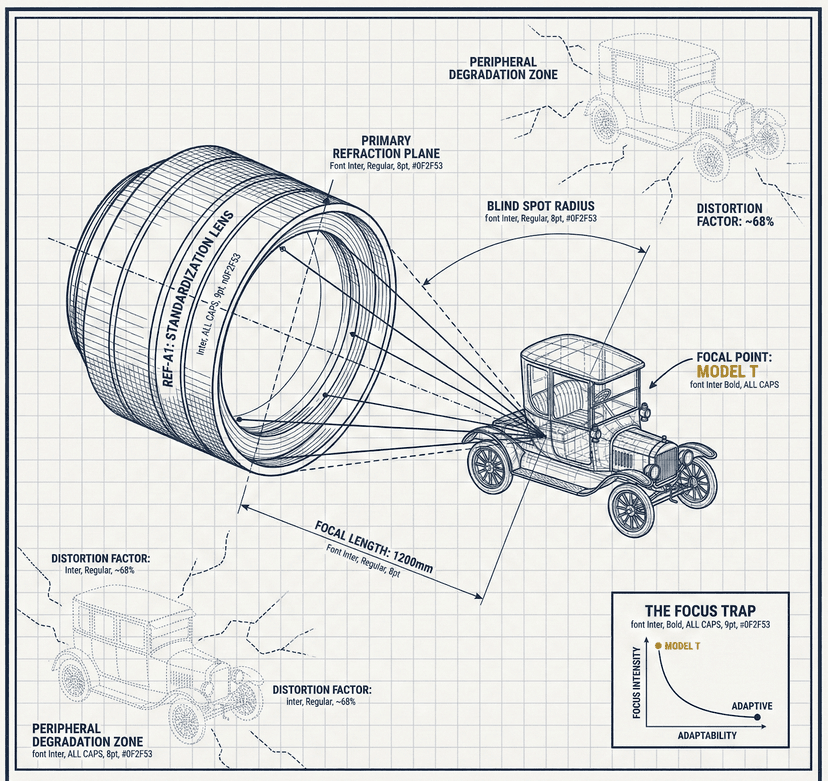
Here is the central question. Not how Ford succeeded. Standardization, the moving assembly line, the five-dollar day, vertical integration from iron mines to dealer showrooms: that part is well documented. The question is why the same mind that revolutionized manufacturing also published anti-Semitic propaganda that Adolf Hitler praised, resisted unionization with hired thugs and pet lions, built a rubber plantation in the Amazon staffed by workers forced to square-dance, and nearly killed his own company by refusing to abandon a car the market had already abandoned first. Ford's triumphs and his disasters came from one trait applied to different problems. Focus enabled breakthrough. Focus prevented adaptation. The certainty that let Ford ignore his critics when they were wrong made him deaf to warnings when they were right.[2]

Machiavelli observed in The Prince that the qualities which bring a ruler to power are rarely the qualities that keep him there. Audacity wins kingdoms; prudence holds them. Ford had audacity in industrial quantities and prudence in none. His story teaches that the capacity for revolutionary achievement and the capacity for catastrophic failure are not opposite ends of a spectrum. They are the same capacity, meeting different conditions.

In evolutionary biology, the parallel is overspecialization. A species that adapts perfectly to one ecological niche dominates it. It also becomes unable to survive anywhere else. The Irish elk grew antlers so massive they became fatal; what won mates could not navigate forests. Ford built a company so optimized for one product that when the product became obsolete, the company nearly followed. Optimization and adaptability are rival forces, and neither nature nor markets send advance notice of which one the next decade will reward.


Dearborn: The Farm Democracy and the Compulsion

"A farm is the best place to get it." — Henry Ford on democracy, 1917

On a July morning in 1876, thirteen-year-old Henry Ford walked eight miles on dirt roads to retrieve a broken tool rather than ask his father for the coins to replace it. William Ford would have given him the money without argument. The walk made no practical sense. That is what makes it diagnostic.

Great founders do not decide to be obsessive. They discover that they already are, the way a patient discovers a fever: retroactively, once the symptoms are undeniable. Ford at thirteen, choosing eight miles of dirt road over a simple request, was already the man who would refuse to abandon the Model T when the market had moved, who would sink $20 million into a rubber plantation he never visited rather than accept dependence on outside suppliers. By seven, he was repairing watches for neighbors. By twelve, he had built his own forge. The compulsion preceded the career by decades.[1]

Ford was born July 30, 1863, in a white farmhouse in Dearborn Township, Michigan. His father had emigrated from Ireland during the famine years and built a prosperous farm through the kind of labor that treats dawn as a starting gun. The family was comfortable but not wealthy. More significantly, the Dearborn farm ran on principles of practical democracy that shaped Ford's industrial philosophy in ways he never examined and could never escape.

Class distinctions barely existed in the world Ford knew as a child. Farmers worked together, shared hardships, judged men by what they could fix, not who their fathers were. Ford grew up eating at the table with hired hands. The gulf between owner and laborer that seemed natural to Eastern industrialists struck Ford as a kind of fiction. "Democracy is a habit of mind," he told Rose Wilder Lane. "A farm is the best place to get it."[1]

This democratic instinct, rooted in manure and weather rather than Locke and Rousseau, explains something that puzzled Ford's contemporaries: his comfort with working people. His closest friend for years was a lunch wagon proprietor named Coffee Jim who sold sandwiches near the Edison power station where Ford worked nights. Ford would spend hours in conversation with machinists and mechanics, building loyalties that more prestigious businessmen could not buy because they would not have known where to shop. The fancy investors came later. The lunch wagon came first.

But the farm planted a more dangerous seed. Farms are closed systems. Inputs go in, outputs come out. Cause connects to effect in visible, physical ways. A broken plow can be fixed by identifying the broken part. A sick cow can be treated by identifying the symptom. Karl Popper would have recognized the epistemology: falsifiable, linear, mechanical. Ford absorbed it so completely that he never questioned whether it applied beyond the fence line, beyond the factory, beyond the world of things that can be disassembled, diagnosed, and repaired. When he later aimed this logic at society, at politics, at the tangled causation of human psychology, the results ranged from paternalistic to monstrous. The farm taught Ford how to think. It did not teach him where thinking stops.


Money as Transmitter

"Money has no value, anyway. It is merely a transmitter, like electricity." — Henry Ford, 1917

In the summer of 1917, Rose Wilder Lane sat with Ford while he explained his philosophy of capital. Ford was already rich. The Model T was selling faster than Highland Park could build it. Lane expected platitudes about hard work. What she got was a theory of money that sounded like it had been dictated by a power station.

"He regards money as an incident in his career," Lane wrote, "a sort of fuel to be poured in unlimited quantities into the tank of a great machine, a transmitter of energy that would otherwise die." The metaphor is electrical: money converts potential into kinetic. Hoarded money is dead current. The purpose of capital is velocity.[1]

Money doesn't do me any good. I can't spend it on myself. Money has no value, anyway. It is merely a transmitter, like electricity. I try to keep it moving as fast as I can, for the best interests of everybody concerned.

Henry Ford

His mentor Thomas Edison would have recognized the frame. Edison spent decades fighting the war of currents, insisting direct current was superior to alternating. He was wrong about that specific question. But the underlying intuition that energy systems require flow, that stored potential without kinetic conversion is waste, shaped how Ford thought about capital two decades before Keynes published The General Theory of Employment, Interest and Money in 1936. The mechanic from Dearborn arrived at a velocity-of-money theory through metaphor while the Cambridge economist was still working it out in calculus.

Ford articulated these ideas before his commercial success could have retroactively justified them. What he told Lane in 1917 matches what he wrote in My Life and Work in 1922 and Today and Tomorrow in 1926.[2][3] The consistency suggests a real intellectual architecture, not a rich man constructing a flattering origin story. Ford had a theory. The theory happened to work for manufacturing. The trouble: Ford could not tell the difference between a theory that was right for factories and a theory that was right for everything.

Sam Walton drove a pickup truck despite being the richest man in America. Warren Buffett still lives in the Omaha house he bought in 1958 for $31,500. Sam Zell called wealth "a great way to keep score but not the object of the game." Employees and investors can smell performance. Ford's indifference to personal luxury was not performance. It was the authentic residue of a Dearborn farmhouse where nobody dressed for dinner, and authenticity of this kind creates trust that no amount of carefully staged humility can replicate.

Ford paired his theory of money with what might be called a democratic theory of value. Early automobiles were luxury items, built for wealthy enthusiasts who wanted prestige. Ford looked at this market and saw waste. "The automobile of those days was like a steam yacht," he told Lane. "It was built for only a few people. Now anything that is good for only a few people is really no good. It's got to be good for everybody or in the end it will not survive."[1]

Extraordinary confidence. Ford was claiming that goods serving only elites were, at some fundamental level, worthless. Hans Wilsdorf, founding Rolex three years before the Model T debuted, reached the opposite conclusion and built one of the most valuable luxury brands in history. Both were right about their markets. Apple under Steve Jobs later proved you could hold both positions simultaneously: democratize access through the iPhone while charging a premium that signals taste. Ford never considered this possibility. A mind that works like a lathe can produce one shape. Productive paradox requires a different kind of tool entirely.


The 999 and the Lunch Wagon: Proving Ground and First Capital

"This chariot may kill me, but they will say afterward that I was going like hell when she took me over the bank." — Barney Oldfield, 1902

Between the midnight test drive of 1896 and the founding of Ford Motor Company in 1903, Ford failed twice, walked away from money, and bet his reputation on a machine that professional drivers refused to sit in.

In 1899, a group of Detroit businessmen offered to finance an automobile company with Ford as chief engineer. Ford accepted. The partnership soured within months. The investors wanted expensive cars for rich buyers. Ford wanted cheap cars for everyone. He walked away. Thirty-six years old, prime working years burned on automobiles, and he had just turned down his only backers.

But Ford had noticed something about investors that investors rarely notice about themselves: they respond to spectacle more readily than to argument. They need, as Lane put it, "letters a mile high." Claude Shannon would formalize this in 1948 as information theory: the signal that cuts through noise is the one with the highest amplitude. Ford did not know Shannon's math. He knew the principle.[1]

Ford built a racing car and named it the "999" after the Empire State Express locomotive No. 999, which on May 10, 1893, had reached 112.5 mph near Batavia, New York, to become the first vehicle in history to officially exceed a hundred miles per hour. Anyone in 1902 caught the reference immediately. Ford was connecting his untested machine to the most celebrated speed record of the previous decade. Branding before branding had a name.

Capital was the bottleneck. Here the story takes a turn no Silicon Valley pitch deck would predict. Ford's savior was Coffee Jim, a lunch wagon owner who had become Ford's friend over years of late-night coffee and conversation. Jim understood nothing about automotive engineering. He understood Ford. When Ford asked for money to build the 999, Jim put it up on a handshake.

See here, Ford, I'll take a chance. I'll back you. You go on, quit your job, build that car and race her. I'll put up the money.

Coffee Jim

Ford offered collateral. Jim refused. "Your word's all I want." Lane called it "one of those accidental friendships which have great consequences." It was older than venture capital and more reliable: trust accumulated through repetition, money given because of who someone was rather than what their projections showed.[1]

With Jim's backing, Ford built the 999. A monster: bare engine mounted on wheels, seat bolted on as an afterthought. No suspension. No differential. No protection. Professional racers looked at it and declined. Ford's partner Tom Cooper found Barney Oldfield, a bicycle racer who had never driven a car but possessed a useful quality: he did not understand engines well enough to know he should be terrified. "This chariot may kill me," Oldfield said, "but they will say afterward that I was going like hell when she took me over the bank."

Oldfield won the October 1902 race against Alexander Winton's machine by half a mile. Half a mile. Modern Formula One races are decided by tenths of a second. Oldfield's margin was not a victory. It was a public execution of doubt. Within months, Ford had backing to start Ford Motor Company.

The racing gambit embedded itself in Ford's corporate DNA. In 1963, Enzo Ferrari walked away from selling his company to Ford, publicly humiliating Henry Ford II. The response: a $25 million racing program with one purpose. Humiliate Ferrari at Le Mans. The GT40 took first, second, and third place in 1966. Insult us in the boardroom, we bury you on the track. Pure Coffee Jim logic: spectacle converts skeptics faster than spreadsheets.

Elon Musk understood the same arithmetic two generations later. Tesla's credibility problem was not engineering; it was perception. So Musk built the Roadster. SpaceX was nearly bankrupt after three failed Falcon 1 launches; the fourth launch did not merely succeed, it transformed the company's entire gravitational field. Binary public success beats years of quiet competence when your product is unproven and your reputation is a rumor.


Clara's Seven Years: The Infrastructure of Genius

"Seven years. Seven years. Henry, at last you've done it." — Clara Bryant Ford, June 4, 1896

On the morning of June 4, 1896, Henry Ford completed his quadricycle in the brick shed behind his rented house on Bagley Avenue in Detroit. Then he tried to wheel it outside and discovered that the machine was wider than the door. The man who would become history's most celebrated optimizer of production processes had not measured the exit. Ford grabbed an axe, smashed through the brick wall, and rolled his automobile into the alley at four in the morning.[4]

Clara Bryant, whom Ford married in 1888, watched alongside his assistant Jim Bishop as Ford sputtered down rain-slicked Detroit streets with Bishop bicycling ahead to warn passersby. According to Lane's account, Clara followed on a bicycle with an umbrella over the exposed engine. She had endured seven years of sacrifice while her husband built his first automobile. The couple lived in cramped rental housing on Ford's salary from the Edison Illuminating Company, roughly $40 to $45 per month. Money was perpetually short. Ford spent every spare hour and every spare dollar on his experiments. Clara managed the household on whatever remained.[1]

When Ford returned to Bagley Avenue at dawn, Clara was waiting with tears streaming down her face. Not upset. Proud.

Seven years. Seven years. Henry, at last you've done it.

Clara Bryant Ford

Behind that sentence lies an entire economy of sacrifice that Ford's biographers have systematically minimized. Lane recognized it because Lane was a woman, and women in 1917 understood household economy as the infrastructure it actually was.[1] Edison did not finance Ford's first automobile. Clara's household economy did. Every dollar Ford spent on machining and parts was a dollar Clara could not spend on food, clothing, or the basic comforts of a life that was already modest. The seven years were her investment as much as his obsession.

Steve Jobs had Laurene, whose memorial speech described years of navigating a husband who could be "not my best self." Jeff Bezos built Amazon while his wife MacKenzie managed their household and drove him to work so he could write business plans in the passenger seat. Behind nearly every founder obsessed enough to change an industry stands a partner absorbing the cost of that obsession. The biographies celebrate the obsession. They rarely itemize the cost.

Clara's role would take a darker turn in later decades. She was among the few people who could influence Ford, and she used that influence at critical moments. When Ford's antisemitic publishing became a legal and reputational crisis, Clara threatened to leave him if he did not shut down the Dearborn Independent. He relented.[5] Thirty-one years after the early-morning ride through the rain, she was still the only person in his life who could make him change course.


The Five-Dollar Day and the Sociological Department

"The payment of five dollars a day for an eight-hour day was one of the finest cost-cutting moves we ever made." — Henry Ford, My Life and Work, 1922

On January 5, 1914, Ford announced that the minimum wage at Ford Motor Company would immediately rise to $5 per day, more than double the prevailing rate of $2.34 for unskilled factory labor. The Wall Street Journal called it "an economic crime." Ford's competitors called him insane.

The next morning, ten thousand men showed up at the Highland Park gates looking for work. Police dispersed the crowd with fire hoses. Every newspaper in America ran the story. Ford had spent nothing on advertising. He had purchased the most valuable publicity in the history of American industry for the price of a pay raise.

His competitors had missed the math. At 370% annual turnover, Ford was hiring 52,000 men each year to maintain a workforce of 14,000. Every departure meant recruiting costs, training costs, quality variance during the learning curve, productivity lost while new hands struggled to match the pace. The $5 Day dropped turnover to 16%. Overnight, Ford went from the worst retention in the industry to the best by a factor of six.[2]

The payment of five dollars a day for an eight-hour day was one of the finest cost-cutting moves we ever made.

Henry Ford, My Life and Work

"Cost-cutting." That was Ford's word. Not generosity. Not welfare. Most businesses optimize for the costs they can see: invoices, budget lines, quarterly expenses. Ford optimized for total cost, including the invisible hemorrhaging his competitors refused to count. They thought he was paying more. He was paying less. The $5 Day was arithmetic that happened to look like philanthropy, which is the most dangerous combination in business, because it lets the person doing the arithmetic believe he is also doing the morality.

And here is where the story needs complication, because this is the passage where admiration is simplest and the trap is closest.

To qualify for the $5 wage, workers had to meet standards of personal conduct. Ford created a Sociological Department: inspectors who visited workers' homes to evaluate their marriages, their savings habits, the cleanliness of their kitchens. Immigrant workers attended mandatory Americanization classes. Workers who failed inspection lost the premium until they brought their domestic lives into compliance with Ford's standards. The department's motto might as well have been we know what's good for you, which was the exact logic of the $5 Day itself, just aimed at a different target.[2]

The man who grew up eating at the table with hired hands, who believed democracy was a habit of mind, who treated Coffee Jim as an equal, was now dispatching inspectors into workers' kitchens to judge how they lived. The instinct had not shifted. Ford believed he understood what people needed. When that belief produced the $5 Day, it was liberation. When it produced the Sociological Department, it was surveillance. Same impulse. Different scope. Opposite result.

If you were advising Ford in January 1914, you would tell him to trust his instincts. His instincts had just produced the most celebrated labor policy in American history. At what point does the advice change? When the home inspections begin? When Americanization classes become mandatory? When inspectors start grading whether workers' wives keep a sufficiently tidy home? The moment when democratic conviction tipped into paternalistic control cannot be identified, because the conviction itself never changed. Only the radius expanded. If you have ever watched a company's greatest cultural strength metastasize into its most toxic policy, you have watched this process in miniature. It is always invisible from inside, because the people enforcing the policy feel exactly as righteous as they felt when the policy was still good.


The Machine at Full Power: Rouge, the Line, and the Buyout

"Failure is the opportunity to begin again, more intelligently." — Henry Ford, 1926

On April 1, 1913, Ford's engineers tried an experiment at Highland Park. They laid out magneto flywheel components along a waist-high surface and assigned each of twenty-nine workers a single operation. Perform the operation, slide the component forward. Assembly time dropped from twenty minutes to thirteen. Within weeks, after raising the line height, adding a chain drive, and cutting the workforce to fourteen, it fell to five.[4]

What happened next changed civilization, and the speed of that change deserves emphasis. Complete car assembly dropped from over twelve hours to ninety-three minutes. The Model T's price fell from $850 in 1908 to $260 by 1925. A Ford worker earning $5 a day could buy a car with ten weeks of wages. By 1927, fifteen million sold. Those numbers are spectacular enough to obscure what the assembly line actually was: the first application of continuous flow to a complex manufactured product. Flour mills had moved grain through continuous processes. Meatpacking plants (which Ford studied with the attention of a doctoral student) moved carcasses past stationary workers. Ford's leap was seeing that continuous flow could govern something with thousands of discrete parts assembled in a specific sequence. The car moved because moving work past the worker was faster than moving the worker to the work. Adam Smith's pin factory, scaled by a factor of ten thousand.

Taiichi Ohno at Toyota called Ford his primary teacher. He studied Highland Park and Rouge the way a medical resident studies a master surgeon: with reverence and a scalpel. But Ohno corrected Ford at the exact point of failure. Ford's assembly line moved in one direction at one speed. Ohno built feedback loops. If a worker spotted a defect, the Andon cord stopped the entire line. Ford treated workers as components in a process. Ohno treated them as sensors, sources of information, people whose judgment the system needed to survive. Toyota's production system surpassed Ford's not by running faster but by listening better. The student honored the teacher by fixing the thing the teacher broke.

River Rouge, which began production in 1928, was the philosophy at maximum amplitude. Raw materials in one end; finished automobiles out the other. Over 100,000 workers, 2,000 acres, 93 buildings. Ford claimed the plant could take iron ore from a mine and deliver a finished car in eighty-one hours. Rouge was elegant the way a suspension bridge is elegant: every force balanced, every element loaded. And the second law of thermodynamics has a prediction about closed systems of this kind. They degrade. Every complex system eventually requires external input, new information, or it loses coherence. Rouge worked brilliantly as long as the external environment held still. When the environment moved, the system's closure became the pathology. The Maginot Line had the same problem, and for the same reason: total optimization against a specific threat creates total vulnerability to every other.

The shareholder buyout cemented Rouge's logic. In 1919, John and Horace Dodge filed suit demanding dividends. The Michigan Supreme Court established a principle that would shape American corporate law for the next century: "A business corporation is organized and carried on primarily for the profit of the stockholders." The philosophy of service before profit sounds admirable in a memoir. In a courtroom, it sounds like grounds for a lawsuit.

Ford's response was characteristic. He bought everyone out. For $106 million (roughly $1.8 billion today), Ford and his son Edsel owned 100 percent of Ford Motor Company. No shareholders. No board oversight. No external check on the founder's judgment. Mark Zuckerberg would later solve this problem more elegantly with supervoting shares, achieving founder control without the capital outlay. Ford solved it with financial force. The buyout enabled everything radical that followed. It also removed every instrument that might have told Ford he was wrong.


The Reckoning: Fordlandia, the Independent, and the Son He Destroyed

"History is more or less bunk." — Henry Ford, Chicago Tribune interview, 1916

In 1927, somewhere in the Brazilian Amazon, workers at a settlement called Fordlandia rioted. They smashed equipment, chased managers into the jungle, set fire to buildings. The proximate causes were the usual colonial grievances: bad food, worse conditions, open contempt for local customs. The deeper cause was that Henry Ford had attempted to build Dearborn, Michigan, on the banks of the Tapajós River, and the river did not cooperate.[7]

Ford had purchased 2.5 million acres of jungle to grow rubber trees, freeing his company from dependence on British-controlled rubber markets. The ambition was recognizably Fordist: vertical integration pushed to its logical conclusion, past the point where logic still applied. Iron ore, timber, rubber, glass, steel, assembly, distribution. Control every link. Depend on no one.

The execution was recognizably Fordist too, in the worst sense. Ford never consulted a botanist. Never visited Brazil. Never asked anyone who had lived in the Amazon whether Michigan farming practices would survive tropics. He imposed American bungalows, American food, mandatory American recreation. Workers ate in cafeterias serving standard midwestern fare. Square dances were organized for entertainment. Square dances. For Brazilian rubber tappers. In the Amazon. The man who prided himself on understanding what workers needed had apparently decided that what Amazonian laborers needed was do-si-dos and a strict prohibition on alcohol. By 1945, Ford had sunk $20 million and harvested not a single pound of commercially usable rubber. The trees, planted in neat rows as any Dearborn farmer would plant them, were destroyed by leaf blight, which spreads easily between closely spaced specimens. In the wild, rubber trees grow scattered through the forest precisely because distance protects them. Ford's orderly rows, his farmer's instinct for neat cultivation, were the pathogen. Nature's apparent disorder was the immune system Ford could not recognize because it looked like inefficiency.[7]

Fordlandia is funny the way all colossal arrogance is funny when viewed from sufficient distance. It is also the Rosetta Stone for everything else that went wrong. If you can understand why Ford planted rubber trees in rows, you can understand the Dearborn Independent.

In 1920, Ford launched the Independent, a weekly newspaper distributed through Ford dealerships. Beginning that May, the paper published "The International Jew," ninety-one articles drawing on the forged "Protocols of the Elders of Zion." Circulation reached 700,000, propelled by the captive distribution network of Ford's own dealers. Adolf Hitler praised Ford in Mein Kampf, kept his portrait in his Munich office, and in 1938 awarded him the Grand Cross of the German Eagle, the highest honor the Nazi government could bestow on a foreign citizen.[6]

The engineering mind that solved production problems by isolating bottlenecks tried to solve social problems by the same method. Aristotle drew the distinction twenty-three centuries ago between techne (craft knowledge, which governs things that can be made) and phronesis (practical wisdom, which governs things that require judgment under uncertainty). Ford had techne in world-historical quantities. He had no phronesis at all, and his epistemology gave him no way to know the difference. Production problems have identifiable causes. Causes can be isolated. Isolated causes can be eliminated. Ford aimed this logic at society and produced conspiracy theories, because conspiracy theories are exactly what linear causal thinking generates when it encounters problems with no single cause. Ford could not think in terms of distributed causation, emergent complexity, or systems where the "problem" has no isolable source. His thinking tools, devastating on the factory floor, became weapons when turned on human affairs. Reductive thinking feels rigorous. It feels like the opposite of bias. That is what makes it dangerous when it escapes the factory.[6]

Ford's decline after 1920 is usually narrated as an aging man losing his grip. The reality is worse and more instructive. Ford's grip never loosened. His certainty stayed absolute. What changed was the world around him, and Ford's system contained no instrument capable of registering the change. It is the difference between a pilot who loses consciousness and a pilot who is wide awake, reading instruments that are disconnected from the aircraft.

Alfred P. Sloan at General Motors grasped what Ford could not: that once everyone had a car, they would want a different car. A better car. A car that said something about who they were. Thorstein Veblen had described the psychology in 1899 as conspicuous consumption. Sloan operationalized it: the annual model change, the brand ladder from Chevrolet to Cadillac, the concept of market segmentation. Ford's response was the most famous sentence in the history of American business: "Any customer can have a car painted any color that he wants so long as it is black." GM passed Ford in market share by 1930. The most efficient production system on earth was manufacturing a product that fewer people wanted each year.

The cruelest chapter was what Ford did to his own son. Edsel Ford represented everything Henry could not accept about the future: market research, design innovation, consumer choice, the Lincoln Zephyr, the V-8. Edsel understood that automobiles had become expressions of identity. Henry could not tolerate this understanding because it invalidated the premise of his entire career. If the customer wanted variety, the Model T philosophy was wrong. If the Model T philosophy was wrong, Ford himself was wrong. And Ford could not be wrong. The architecture of his mind did not include that possibility.

So Henry destroyed Edsel. He overruled his decisions. He humiliated him in front of employees. He allowed Harry Bennett, a former boxer with organized crime connections, to build a private security apparatus that rivaled the authority of the president's office. Bennett's Service Department used intimidation, surveillance, and violence. He kept a shooting range in his office basement and reportedly fired a pistol during meetings, which is one way to resolve disagreements about production schedules. He maintained a network of informants throughout the company and kept pet lions and tigers at his personal compound, because apparently the human intimidation alone left some doubt about his management style. Ford Motor Company in the 1930s was less a corporation than a fiefdom with smokestacks.[5]

Edsel died on May 26, 1943, at forty-nine. Stomach cancer, undulant fever. Contemporaries, including Ford family members, believed the stress of his impossible position contributed.[5] The father who invented the assembly line had used his authority to break his own son. King Lear without the self-knowledge. If you have ever watched a founder systematically undermine a successor whose instincts are better calibrated to the current market, you have watched the Ford pattern repeat. The driver is not spite. It is existential threat. The successor's competence is proof that the founder's era has ended, and that proof is the one thing the founder's psychology will not metabolize.

Ford was the last major American automaker to accept unionization. When the United Auto Workers organized the Battle of the Overpass in May 1937, Bennett's men beat organizers Walter Reuther and Richard Frankensteen in full view of press photographers. The images became some of the most widely published photographs of the American labor movement.[6] Ford signed a union contract in 1941, and then only because Clara threatened to leave him.

Clara again. The woman who followed the quadricycle through rain in 1896, who threatened to leave over the Dearborn Independent, now making the identical threat over labor rights. The last external check on a system that had eliminated every other one. Thirty-one years of marriage, and her influence had not increased. Everything else had simply been destroyed.


The Mechanic's Toolkit: Five Structural Interventions from the Ford Contradiction

"The man who needs to hear that his judgment has failed is, by definition, the man who trusts his judgment most." — Long Arc Research

Why the obvious advice fails, and what to try instead

Every business book that cites Ford extracts one lesson: focus wins. Stay committed to your vision. Ignore the naysayers. Double down. You will find it in every executive coaching program, every offsite workbook, every keynote that opens with the Model T and closes with a call to conviction. It is also the advice that kept Ford building a car nobody wanted for seven years after GM proved the market had moved.

The advice fails because it operates at the wrong level. "Stay focused" is a prescription for individual behavior. But the pattern Ford documents is systemic: the relationship between the operator, the organization, the market, and the feedback loops connecting all three. Ford lacked a way to register when his focus had shifted from asset to liability. No amount of individual self-awareness could have provided this, because the condition renders self-awareness unreliable. The man who needs to hear that his judgment has failed is, by definition, the man who trusts his judgment most.

The five practices that follow are derived from the specific episodes documented in this volume. They are systemic interventions, not personal ones. They work on the architecture, not the soul.


Coffee Jim's Test

Who in your current life would bet their own money on your judgment, and would they tell you the bet was foolish before writing the check?

Coffee Jim could do both. Years of late-night conversation at his lunch counter had given him unmediated access to Ford's thinking, and he had nothing to gain from flattery. He was a man who sold sandwiches, and he could afford to tell Ford the truth because their relationship had no power asymmetry to corrupt it. Clara occupied the same position: she saw Ford's obsessions from the vantage of someone absorbing their daily cost. Edison evaluated Ford's engineering as a peer, not a subordinate.

Each of these people had both the information and the independence to tell Ford he was wrong. By the 1930s, every one of those properties had been eliminated. Ford's inner circle consisted of Harry Bennett, who maintained power by confirming whatever Ford already believed.

The question is not "do I seek honest feedback?" Everyone thinks they do. The operational test: write down the names of three people who would tell you your flagship initiative is failing. For each one, ask whether their income, their status, or their access to you depends on your approval. If yes, they are not the person. If you cannot name three people who pass this test, your information environment has already degraded. You will not feel it degrading. Ford did not feel it. He felt more certain, not less, as the circle of honest voices shrank to zero.


The Sociological Department Inversion

What happens when the instinct behind the Five-Dollar Day keeps going?

The wage announcement was the product of Ford's certainty that he knew what workers needed. That certainty was correct about compensation. Within months, it produced a Sociological Department whose inspectors visited workers' homes to evaluate their marriages, their diets, and the cleanliness of their kitchens. The distance between "I know what wage they need" and "I know how they should live" was invisible to Ford because the conviction powering both conclusions felt identical from the inside.

Forget "good intentions going wrong." That cliché lets the reader off the hook. This is amplification: a system that rewards a belief will push that belief further than the person holding it ever intended, because each success makes the next extension feel obligatory. Ford did not wake up one morning and decide to police his workers' domestic lives. The system carried him there one validated decision at a time.

The practice is architectural. For every policy rooted in your strongest conviction, write a sunset clause or a hard boundary into the policy document before you announce it. Not a suggestion. Not a review process someone can waive. A clause that triggers automatically: the policy expires in eighteen months unless independently reauthorized, or it cannot extend beyond a defined scope without board approval. Ford's system had no walls because Ford's certainty could not conceive of a reason to build them. Build them before you need them, because by the time you need them, you will not believe you do.


Fordlandia's Mirror

The Fordlandia episode documented earlier in this volume is instructive beyond the arrogance. It reveals the invisible architecture of domain transfer: the assumptions you carry from one field into another without knowing you are carrying them. Ford's assumptions were agricultural (rows are efficient), industrial (standardization works), and cultural (American practices are superior). Each was so embedded in his success that it registered as reality rather than assumption.

When entering any domain where you lack native experience, operate on the premise that you are carrying at least three assumptions from your previous domain, that you cannot identify them yourself, and that someone native to the new domain can identify them in minutes. Find that person. Do not ask them whether your assumptions might be wrong. Tell them your assumptions are wrong and ask them to identify which ones. The framing matters. "Might be wrong" invites politeness. "Are wrong" invites specificity.

The botanist Ford never hired would have looked at the neat rows of rubber trees and known, in an afternoon, what Ford could not learn in two decades. In your version: before launching in a new domain, hire the equivalent of that botanist for a single paid afternoon of structured criticism. Give them your plan. Tell them to find three assumptions you are importing from your previous success. Budget for it the way you budget for legal review. The cost of an afternoon is trivial. The cost of Fordlandia was $20 million and two decades.


The Model T Shelf Life

Between 1921 and 1926, the Model T's market share fell from 56% to 34%. During those same five years, every internal metric Ford tracked was improving. Unit costs went down. Production speed went up. The dashboard said the machine was getting better. The market said the machine was making the wrong thing, and the dashboard had no instrument that measured the difference.

This is the optimization trap. Its defining feature: it cannot be detected from inside. The better your numbers look, the harder it is to believe they are measuring something that no longer matters. Sloan at GM built a different category entirely: cars as identity, as aspiration, as annual renewal. Ford's production system, optimized beyond anything the world had seen for one specific car, could not produce anything else without being rebuilt from the ground up.

Identify the product, process, or capability your organization has optimized most aggressively. Calculate the switching cost: if this capability had to be abandoned in twelve months, what would the transition require? If the answer is "we would essentially have to start over," you have built Rouge. Now schedule a quarterly external review. Someone outside your organization, without access to your internal metrics, evaluates whether the market still wants what your metrics are optimizing for. Ford measured production efficiency. He should have been measuring whether anyone still wanted what he was producing. The numbers were excellent. The numbers were measuring the wrong thing. Every quarter your metrics improve while your market share declines, you are Ford in 1924. The dashboard is lying to you, and it is lying with real numbers.


Edsel's Desk

The Edsel story documented in the preceding section is the hardest practice in this toolkit, because it touches the founder's identity rather than the founder's operations.

Edsel's ideas implied that the customer's preferences mattered more than the manufacturer's vision. Henry could not tolerate this because accepting it would mean the Model T philosophy was wrong. If the Model T philosophy was wrong, then the premise on which Henry Ford had built his identity, his company, and his understanding of the world was a mistake. The successor represented a world in which the founder's era had ended.

Identify the person in your organization whose instincts irritate you most. Ask whether the irritation comes from their being wrong or from their representing a version of the enterprise that does not need you in your current role. The distinction is nearly impossible to make honestly, which is why the test must be architectural rather than introspective: give that person real authority in a domain you do not control. Not advisory authority. Not "input." Decision-making power with measurable outcomes, evaluated by someone other than you. If they outperform your instincts, the succession has already begun whether you are ready or not.

This practice is different from the other four. It may not work. Ford could not have run this test even if someone had handed it to him, because running it would have required accepting the possibility that Edsel was right, and that possibility was existentially intolerable. Some interventions fail because the pattern they are trying to correct is load-bearing for the founder's identity. If that is the case, the only question left is whether the organization survives the founder. Ford Motor Company barely did.


It would be satisfying to end with five clean practices and the implication that applying them will prevent the Ford outcome. But the Ford contradiction has one final property that this volume cannot ignore: the very condition these practices address makes them hardest to apply when they are most needed.

Ford in 1925 had access to every piece of information that would have told him the Model T was dying. He had Edsel, who was right. He had the sales numbers, which were declining. He had General Motors, which was winning. He had Clara, who could still reach him on matters of conscience if not strategy. None of it penetrated. The information existed. The processing system rejected it because accepting it would have required Ford to revise the premise on which his identity, his company, and his understanding of the world all rested. The toolkit above is the best defense available against the condition his life documents. It is not a guarantee. It cannot be.

On the night of April 7, 1947, servants held candles around the bed of the man who brought electric light to millions. The spring flood had knocked out power to the estate. Ford lay in a room illuminated by the technology his factories had made obsolete, in a house darkened by an event his systems could not control. Outside, the twentieth century he had built hummed along without him, already running on principles his son had understood and he had spent two decades destroying. The candles were still burning when he stopped breathing. Nobody recorded who blew them out.

Contextual Notes

Annotations appear here as you scroll through the dossier. Hover over highlighted names for detailed cards.

Scroll to see contextual notes for each section.

Henry Ford IndexThe Machine That Built America
LONG ARC RESEARCH

Three platforms for better thinking.

Platforms
  • Legends
  • Explore
  • Through Line
  • Field Notes
  • Pricing
Resources
  • Mental Models
  • Playbooks
  • Atlas
  • Books
Company
  • About
  • How It Works
  • FAQ
  • Contact
Legal
  • Privacy Policy
  • Terms of Service
  • Refund Policy

© 2026 Long Arc Research. All rights reserved.

Long Arc Research
HOME
LEGENDS
EXPLORE
THROUGH LINE
FIELD NOTES
Long Arc Research
📧

Verify your email to unlock all content

Back to Henry FordHenry Ford
0%
Back to Henry Ford Index
Henry Ford
Legend Dossier

Henry Ford

The Mechanic Who Mistook His Factory for the World

Lived1863-1947
IndustryAutomotive
Reading Time~29 minutes
Builder-ConstructorSystems ThinkerOperatorOperations & ExecutionPsychology & BehaviorBusiness & Entrepreneurship
Download Volume PDF

“Money doesn't do me any good. I can't spend it on myself. Money has no value, anyway. It is merely a transmitter, like electricity.”

Henry Ford, 1917

Scroll to begin
In This Dossier
  • The Paradox of Perfect Focus
  • Dearborn: The Farm Democracy and the Compulsion
  • Money as Transmitter
  • The 999 and the Lunch Wagon
  • Clara's Seven Years
  • The Five-Dollar Day and the Sociological Department
  • The Machine at Full Power
  • The Reckoning
  • The Mechanic's Toolkit
Archetypes
Builder-ConstructorSystems ThinkerOperator
Disciplines
Operations & ExecutionPsychology & BehaviorBusiness & Entrepreneurship
Key Motifs
Vertical IntegrationCost CompressionStandardizationScale EconomiesFocus DisciplineFeedback LoopsPath DependenceCounter Positioning

The Paradox of Perfect Focus

"Whether I am a visionary or not I don't know, but the idea of a car for everyday use struck me first." — Henry Ford to Rose Wilder Lane, 1917

Henry Ford died by candlelight. On April 7, 1947, a spring flood knocked out electricity to Fair Lane, his Dearborn estate. Servants held flames around the bed. The man who brought electric power to millions went out in a room lit by wax and wick, as if the century had briefly remembered what it owed him and then reversed the debt.

He had visited Greenfield Village that afternoon, the museum he built to preserve the pre-industrial past he had done more than anyone to destroy. Edison's Menlo Park laboratory was there. So was the Wright Brothers' bicycle shop. Every exhibit preserved the moment of creation. None preserved what came after.

The irony would have been lost on Ford. He never grasped irony. His mind worked the way a lathe works: it removed everything that was not the desired shape. Aimed at manufacturing, this produced results that changed civilization. Aimed at politics, society, or human psychology, it produced the Dearborn Independent.

Here is the central question. Not how Ford succeeded. Standardization, the moving assembly line, the five-dollar day, vertical integration from iron mines to dealer showrooms: that part is well documented. The question is why the same mind that revolutionized manufacturing also published anti-Semitic propaganda that Adolf Hitler praised, resisted unionization with hired thugs and pet lions, built a rubber plantation in the Amazon staffed by workers forced to square-dance, and nearly killed his own company by refusing to abandon a car the market had already abandoned first. Ford's triumphs and his disasters came from one trait applied to different problems. Focus enabled breakthrough. Focus prevented adaptation. The certainty that let Ford ignore his critics when they were wrong made him deaf to warnings when they were right.[2]

Machiavelli observed in The Prince that the qualities which bring a ruler to power are rarely the qualities that keep him there. Audacity wins kingdoms; prudence holds them. Ford had audacity in industrial quantities and prudence in none. His story teaches that the capacity for revolutionary achievement and the capacity for catastrophic failure are not opposite ends of a spectrum. They are the same capacity, meeting different conditions.

In evolutionary biology, the parallel is overspecialization. A species that adapts perfectly to one ecological niche dominates it. It also becomes unable to survive anywhere else. The Irish elk grew antlers so massive they became fatal; what won mates could not navigate forests. Ford built a company so optimized for one product that when the product became obsolete, the company nearly followed. Optimization and adaptability are rival forces, and neither nature nor markets send advance notice of which one the next decade will reward.


Dearborn: The Farm Democracy and the Compulsion

"A farm is the best place to get it." — Henry Ford on democracy, 1917

On a July morning in 1876, thirteen-year-old Henry Ford walked eight miles on dirt roads to retrieve a broken tool rather than ask his father for the coins to replace it. William Ford would have given him the money without argument. The walk made no practical sense. That is what makes it diagnostic.

Great founders do not decide to be obsessive. They discover that they already are, the way a patient discovers a fever: retroactively, once the symptoms are undeniable. Ford at thirteen, choosing eight miles of dirt road over a simple request, was already the man who would refuse to abandon the Model T when the market had moved, who would sink $20 million into a rubber plantation he never visited rather than accept dependence on outside suppliers. By seven, he was repairing watches for neighbors. By twelve, he had built his own forge. The compulsion preceded the career by decades.[1]

Ford was born July 30, 1863, in a white farmhouse in Dearborn Township, Michigan. His father had emigrated from Ireland during the famine years and built a prosperous farm through the kind of labor that treats dawn as a starting gun. The family was comfortable but not wealthy. More significantly, the Dearborn farm ran on principles of practical democracy that shaped Ford's industrial philosophy in ways he never examined and could never escape.

Class distinctions barely existed in the world Ford knew as a child. Farmers worked together, shared hardships, judged men by what they could fix, not who their fathers were. Ford grew up eating at the table with hired hands. The gulf between owner and laborer that seemed natural to Eastern industrialists struck Ford as a kind of fiction. "Democracy is a habit of mind," he told Rose Wilder Lane. "A farm is the best place to get it."[1]

This democratic instinct, rooted in manure and weather rather than Locke and Rousseau, explains something that puzzled Ford's contemporaries: his comfort with working people. His closest friend for years was a lunch wagon proprietor named Coffee Jim who sold sandwiches near the Edison power station where Ford worked nights. Ford would spend hours in conversation with machinists and mechanics, building loyalties that more prestigious businessmen could not buy because they would not have known where to shop. The fancy investors came later. The lunch wagon came first.

But the farm planted a more dangerous seed. Farms are closed systems. Inputs go in, outputs come out. Cause connects to effect in visible, physical ways. A broken plow can be fixed by identifying the broken part. A sick cow can be treated by identifying the symptom. Karl Popper would have recognized the epistemology: falsifiable, linear, mechanical. Ford absorbed it so completely that he never questioned whether it applied beyond the fence line, beyond the factory, beyond the world of things that can be disassembled, diagnosed, and repaired. When he later aimed this logic at society, at politics, at the tangled causation of human psychology, the results ranged from paternalistic to monstrous. The farm taught Ford how to think. It did not teach him where thinking stops.


Money as Transmitter

"Money has no value, anyway. It is merely a transmitter, like electricity." — Henry Ford, 1917

In the summer of 1917, Rose Wilder Lane sat with Ford while he explained his philosophy of capital. Ford was already rich. The Model T was selling faster than Highland Park could build it. Lane expected platitudes about hard work. What she got was a theory of money that sounded like it had been dictated by a power station.

"He regards money as an incident in his career," Lane wrote, "a sort of fuel to be poured in unlimited quantities into the tank of a great machine, a transmitter of energy that would otherwise die." The metaphor is electrical: money converts potential into kinetic. Hoarded money is dead current. The purpose of capital is velocity.[1]

Money doesn't do me any good. I can't spend it on myself. Money has no value, anyway. It is merely a transmitter, like electricity. I try to keep it moving as fast as I can, for the best interests of everybody concerned.

Henry Ford

His mentor Thomas Edison would have recognized the frame. Edison spent decades fighting the war of currents, insisting direct current was superior to alternating. He was wrong about that specific question. But the underlying intuition that energy systems require flow, that stored potential without kinetic conversion is waste, shaped how Ford thought about capital two decades before Keynes published The General Theory of Employment, Interest and Money in 1936. The mechanic from Dearborn arrived at a velocity-of-money theory through metaphor while the Cambridge economist was still working it out in calculus.

Ford articulated these ideas before his commercial success could have retroactively justified them. What he told Lane in 1917 matches what he wrote in My Life and Work in 1922 and Today and Tomorrow in 1926.[2][3] The consistency suggests a real intellectual architecture, not a rich man constructing a flattering origin story. Ford had a theory. The theory happened to work for manufacturing. The trouble: Ford could not tell the difference between a theory that was right for factories and a theory that was right for everything.

Sam Walton drove a pickup truck despite being the richest man in America. Warren Buffett still lives in the Omaha house he bought in 1958 for $31,500. Sam Zell called wealth "a great way to keep score but not the object of the game." Employees and investors can smell performance. Ford's indifference to personal luxury was not performance. It was the authentic residue of a Dearborn farmhouse where nobody dressed for dinner, and authenticity of this kind creates trust that no amount of carefully staged humility can replicate.

Ford paired his theory of money with what might be called a democratic theory of value. Early automobiles were luxury items, built for wealthy enthusiasts who wanted prestige. Ford looked at this market and saw waste. "The automobile of those days was like a steam yacht," he told Lane. "It was built for only a few people. Now anything that is good for only a few people is really no good. It's got to be good for everybody or in the end it will not survive."[1]

Extraordinary confidence. Ford was claiming that goods serving only elites were, at some fundamental level, worthless. Hans Wilsdorf, founding Rolex three years before the Model T debuted, reached the opposite conclusion and built one of the most valuable luxury brands in history. Both were right about their markets. Apple under Steve Jobs later proved you could hold both positions simultaneously: democratize access through the iPhone while charging a premium that signals taste. Ford never considered this possibility. A mind that works like a lathe can produce one shape. Productive paradox requires a different kind of tool entirely.


The 999 and the Lunch Wagon: Proving Ground and First Capital

"This chariot may kill me, but they will say afterward that I was going like hell when she took me over the bank." — Barney Oldfield, 1902

Between the midnight test drive of 1896 and the founding of Ford Motor Company in 1903, Ford failed twice, walked away from money, and bet his reputation on a machine that professional drivers refused to sit in.

In 1899, a group of Detroit businessmen offered to finance an automobile company with Ford as chief engineer. Ford accepted. The partnership soured within months. The investors wanted expensive cars for rich buyers. Ford wanted cheap cars for everyone. He walked away. Thirty-six years old, prime working years burned on automobiles, and he had just turned down his only backers.

But Ford had noticed something about investors that investors rarely notice about themselves: they respond to spectacle more readily than to argument. They need, as Lane put it, "letters a mile high." Claude Shannon would formalize this in 1948 as information theory: the signal that cuts through noise is the one with the highest amplitude. Ford did not know Shannon's math. He knew the principle.[1]

Ford built a racing car and named it the "999" after the Empire State Express locomotive No. 999, which on May 10, 1893, had reached 112.5 mph near Batavia, New York, to become the first vehicle in history to officially exceed a hundred miles per hour. Anyone in 1902 caught the reference immediately. Ford was connecting his untested machine to the most celebrated speed record of the previous decade. Branding before branding had a name.

Capital was the bottleneck. Here the story takes a turn no Silicon Valley pitch deck would predict. Ford's savior was Coffee Jim, a lunch wagon owner who had become Ford's friend over years of late-night coffee and conversation. Jim understood nothing about automotive engineering. He understood Ford. When Ford asked for money to build the 999, Jim put it up on a handshake.

See here, Ford, I'll take a chance. I'll back you. You go on, quit your job, build that car and race her. I'll put up the money.

Coffee Jim

Ford offered collateral. Jim refused. "Your word's all I want." Lane called it "one of those accidental friendships which have great consequences." It was older than venture capital and more reliable: trust accumulated through repetition, money given because of who someone was rather than what their projections showed.[1]

With Jim's backing, Ford built the 999. A monster: bare engine mounted on wheels, seat bolted on as an afterthought. No suspension. No differential. No protection. Professional racers looked at it and declined. Ford's partner Tom Cooper found Barney Oldfield, a bicycle racer who had never driven a car but possessed a useful quality: he did not understand engines well enough to know he should be terrified. "This chariot may kill me," Oldfield said, "but they will say afterward that I was going like hell when she took me over the bank."

Oldfield won the October 1902 race against Alexander Winton's machine by half a mile. Half a mile. Modern Formula One races are decided by tenths of a second. Oldfield's margin was not a victory. It was a public execution of doubt. Within months, Ford had backing to start Ford Motor Company.

The racing gambit embedded itself in Ford's corporate DNA. In 1963, Enzo Ferrari walked away from selling his company to Ford, publicly humiliating Henry Ford II. The response: a $25 million racing program with one purpose. Humiliate Ferrari at Le Mans. The GT40 took first, second, and third place in 1966. Insult us in the boardroom, we bury you on the track. Pure Coffee Jim logic: spectacle converts skeptics faster than spreadsheets.

Elon Musk understood the same arithmetic two generations later. Tesla's credibility problem was not engineering; it was perception. So Musk built the Roadster. SpaceX was nearly bankrupt after three failed Falcon 1 launches; the fourth launch did not merely succeed, it transformed the company's entire gravitational field. Binary public success beats years of quiet competence when your product is unproven and your reputation is a rumor.


Clara's Seven Years: The Infrastructure of Genius

"Seven years. Seven years. Henry, at last you've done it." — Clara Bryant Ford, June 4, 1896

On the morning of June 4, 1896, Henry Ford completed his quadricycle in the brick shed behind his rented house on Bagley Avenue in Detroit. Then he tried to wheel it outside and discovered that the machine was wider than the door. The man who would become history's most celebrated optimizer of production processes had not measured the exit. Ford grabbed an axe, smashed through the brick wall, and rolled his automobile into the alley at four in the morning.[4]

Clara Bryant, whom Ford married in 1888, watched alongside his assistant Jim Bishop as Ford sputtered down rain-slicked Detroit streets with Bishop bicycling ahead to warn passersby. According to Lane's account, Clara followed on a bicycle with an umbrella over the exposed engine. She had endured seven years of sacrifice while her husband built his first automobile. The couple lived in cramped rental housing on Ford's salary from the Edison Illuminating Company, roughly $40 to $45 per month. Money was perpetually short. Ford spent every spare hour and every spare dollar on his experiments. Clara managed the household on whatever remained.[1]

When Ford returned to Bagley Avenue at dawn, Clara was waiting with tears streaming down her face. Not upset. Proud.

Seven years. Seven years. Henry, at last you've done it.

Clara Bryant Ford

Behind that sentence lies an entire economy of sacrifice that Ford's biographers have systematically minimized. Lane recognized it because Lane was a woman, and women in 1917 understood household economy as the infrastructure it actually was.[1] Edison did not finance Ford's first automobile. Clara's household economy did. Every dollar Ford spent on machining and parts was a dollar Clara could not spend on food, clothing, or the basic comforts of a life that was already modest. The seven years were her investment as much as his obsession.

Steve Jobs had Laurene, whose memorial speech described years of navigating a husband who could be "not my best self." Jeff Bezos built Amazon while his wife MacKenzie managed their household and drove him to work so he could write business plans in the passenger seat. Behind nearly every founder obsessed enough to change an industry stands a partner absorbing the cost of that obsession. The biographies celebrate the obsession. They rarely itemize the cost.

Clara's role would take a darker turn in later decades. She was among the few people who could influence Ford, and she used that influence at critical moments. When Ford's antisemitic publishing became a legal and reputational crisis, Clara threatened to leave him if he did not shut down the Dearborn Independent. He relented.[5] Thirty-one years after the early-morning ride through the rain, she was still the only person in his life who could make him change course.


The Five-Dollar Day and the Sociological Department

"The payment of five dollars a day for an eight-hour day was one of the finest cost-cutting moves we ever made." — Henry Ford, My Life and Work, 1922

On January 5, 1914, Ford announced that the minimum wage at Ford Motor Company would immediately rise to $5 per day, more than double the prevailing rate of $2.34 for unskilled factory labor. The Wall Street Journal called it "an economic crime." Ford's competitors called him insane.

The next morning, ten thousand men showed up at the Highland Park gates looking for work. Police dispersed the crowd with fire hoses. Every newspaper in America ran the story. Ford had spent nothing on advertising. He had purchased the most valuable publicity in the history of American industry for the price of a pay raise.

His competitors had missed the math. At 370% annual turnover, Ford was hiring 52,000 men each year to maintain a workforce of 14,000. Every departure meant recruiting costs, training costs, quality variance during the learning curve, productivity lost while new hands struggled to match the pace. The $5 Day dropped turnover to 16%. Overnight, Ford went from the worst retention in the industry to the best by a factor of six.[2]

The payment of five dollars a day for an eight-hour day was one of the finest cost-cutting moves we ever made.

Henry Ford, My Life and Work

"Cost-cutting." That was Ford's word. Not generosity. Not welfare. Most businesses optimize for the costs they can see: invoices, budget lines, quarterly expenses. Ford optimized for total cost, including the invisible hemorrhaging his competitors refused to count. They thought he was paying more. He was paying less. The $5 Day was arithmetic that happened to look like philanthropy, which is the most dangerous combination in business, because it lets the person doing the arithmetic believe he is also doing the morality.

And here is where the story needs complication, because this is the passage where admiration is simplest and the trap is closest.

To qualify for the $5 wage, workers had to meet standards of personal conduct. Ford created a Sociological Department: inspectors who visited workers' homes to evaluate their marriages, their savings habits, the cleanliness of their kitchens. Immigrant workers attended mandatory Americanization classes. Workers who failed inspection lost the premium until they brought their domestic lives into compliance with Ford's standards. The department's motto might as well have been we know what's good for you, which was the exact logic of the $5 Day itself, just aimed at a different target.[2]

The man who grew up eating at the table with hired hands, who believed democracy was a habit of mind, who treated Coffee Jim as an equal, was now dispatching inspectors into workers' kitchens to judge how they lived. The instinct had not shifted. Ford believed he understood what people needed. When that belief produced the $5 Day, it was liberation. When it produced the Sociological Department, it was surveillance. Same impulse. Different scope. Opposite result.

If you were advising Ford in January 1914, you would tell him to trust his instincts. His instincts had just produced the most celebrated labor policy in American history. At what point does the advice change? When the home inspections begin? When Americanization classes become mandatory? When inspectors start grading whether workers' wives keep a sufficiently tidy home? The moment when democratic conviction tipped into paternalistic control cannot be identified, because the conviction itself never changed. Only the radius expanded. If you have ever watched a company's greatest cultural strength metastasize into its most toxic policy, you have watched this process in miniature. It is always invisible from inside, because the people enforcing the policy feel exactly as righteous as they felt when the policy was still good.


The Machine at Full Power: Rouge, the Line, and the Buyout

"Failure is the opportunity to begin again, more intelligently." — Henry Ford, 1926

On April 1, 1913, Ford's engineers tried an experiment at Highland Park. They laid out magneto flywheel components along a waist-high surface and assigned each of twenty-nine workers a single operation. Perform the operation, slide the component forward. Assembly time dropped from twenty minutes to thirteen. Within weeks, after raising the line height, adding a chain drive, and cutting the workforce to fourteen, it fell to five.[4]

What happened next changed civilization, and the speed of that change deserves emphasis. Complete car assembly dropped from over twelve hours to ninety-three minutes. The Model T's price fell from $850 in 1908 to $260 by 1925. A Ford worker earning $5 a day could buy a car with ten weeks of wages. By 1927, fifteen million sold. Those numbers are spectacular enough to obscure what the assembly line actually was: the first application of continuous flow to a complex manufactured product. Flour mills had moved grain through continuous processes. Meatpacking plants (which Ford studied with the attention of a doctoral student) moved carcasses past stationary workers. Ford's leap was seeing that continuous flow could govern something with thousands of discrete parts assembled in a specific sequence. The car moved because moving work past the worker was faster than moving the worker to the work. Adam Smith's pin factory, scaled by a factor of ten thousand.

Taiichi Ohno at Toyota called Ford his primary teacher. He studied Highland Park and Rouge the way a medical resident studies a master surgeon: with reverence and a scalpel. But Ohno corrected Ford at the exact point of failure. Ford's assembly line moved in one direction at one speed. Ohno built feedback loops. If a worker spotted a defect, the Andon cord stopped the entire line. Ford treated workers as components in a process. Ohno treated them as sensors, sources of information, people whose judgment the system needed to survive. Toyota's production system surpassed Ford's not by running faster but by listening better. The student honored the teacher by fixing the thing the teacher broke.

River Rouge, which began production in 1928, was the philosophy at maximum amplitude. Raw materials in one end; finished automobiles out the other. Over 100,000 workers, 2,000 acres, 93 buildings. Ford claimed the plant could take iron ore from a mine and deliver a finished car in eighty-one hours. Rouge was elegant the way a suspension bridge is elegant: every force balanced, every element loaded. And the second law of thermodynamics has a prediction about closed systems of this kind. They degrade. Every complex system eventually requires external input, new information, or it loses coherence. Rouge worked brilliantly as long as the external environment held still. When the environment moved, the system's closure became the pathology. The Maginot Line had the same problem, and for the same reason: total optimization against a specific threat creates total vulnerability to every other.

The shareholder buyout cemented Rouge's logic. In 1919, John and Horace Dodge filed suit demanding dividends. The Michigan Supreme Court established a principle that would shape American corporate law for the next century: "A business corporation is organized and carried on primarily for the profit of the stockholders." The philosophy of service before profit sounds admirable in a memoir. In a courtroom, it sounds like grounds for a lawsuit.

Ford's response was characteristic. He bought everyone out. For $106 million (roughly $1.8 billion today), Ford and his son Edsel owned 100 percent of Ford Motor Company. No shareholders. No board oversight. No external check on the founder's judgment. Mark Zuckerberg would later solve this problem more elegantly with supervoting shares, achieving founder control without the capital outlay. Ford solved it with financial force. The buyout enabled everything radical that followed. It also removed every instrument that might have told Ford he was wrong.


The Reckoning: Fordlandia, the Independent, and the Son He Destroyed

"History is more or less bunk." — Henry Ford, Chicago Tribune interview, 1916

In 1927, somewhere in the Brazilian Amazon, workers at a settlement called Fordlandia rioted. They smashed equipment, chased managers into the jungle, set fire to buildings. The proximate causes were the usual colonial grievances: bad food, worse conditions, open contempt for local customs. The deeper cause was that Henry Ford had attempted to build Dearborn, Michigan, on the banks of the Tapajós River, and the river did not cooperate.[7]

Ford had purchased 2.5 million acres of jungle to grow rubber trees, freeing his company from dependence on British-controlled rubber markets. The ambition was recognizably Fordist: vertical integration pushed to its logical conclusion, past the point where logic still applied. Iron ore, timber, rubber, glass, steel, assembly, distribution. Control every link. Depend on no one.

The execution was recognizably Fordist too, in the worst sense. Ford never consulted a botanist. Never visited Brazil. Never asked anyone who had lived in the Amazon whether Michigan farming practices would survive tropics. He imposed American bungalows, American food, mandatory American recreation. Workers ate in cafeterias serving standard midwestern fare. Square dances were organized for entertainment. Square dances. For Brazilian rubber tappers. In the Amazon. The man who prided himself on understanding what workers needed had apparently decided that what Amazonian laborers needed was do-si-dos and a strict prohibition on alcohol. By 1945, Ford had sunk $20 million and harvested not a single pound of commercially usable rubber. The trees, planted in neat rows as any Dearborn farmer would plant them, were destroyed by leaf blight, which spreads easily between closely spaced specimens. In the wild, rubber trees grow scattered through the forest precisely because distance protects them. Ford's orderly rows, his farmer's instinct for neat cultivation, were the pathogen. Nature's apparent disorder was the immune system Ford could not recognize because it looked like inefficiency.[7]

Fordlandia is funny the way all colossal arrogance is funny when viewed from sufficient distance. It is also the Rosetta Stone for everything else that went wrong. If you can understand why Ford planted rubber trees in rows, you can understand the Dearborn Independent.

In 1920, Ford launched the Independent, a weekly newspaper distributed through Ford dealerships. Beginning that May, the paper published "The International Jew," ninety-one articles drawing on the forged "Protocols of the Elders of Zion." Circulation reached 700,000, propelled by the captive distribution network of Ford's own dealers. Adolf Hitler praised Ford in Mein Kampf, kept his portrait in his Munich office, and in 1938 awarded him the Grand Cross of the German Eagle, the highest honor the Nazi government could bestow on a foreign citizen.[6]

The engineering mind that solved production problems by isolating bottlenecks tried to solve social problems by the same method. Aristotle drew the distinction twenty-three centuries ago between techne (craft knowledge, which governs things that can be made) and phronesis (practical wisdom, which governs things that require judgment under uncertainty). Ford had techne in world-historical quantities. He had no phronesis at all, and his epistemology gave him no way to know the difference. Production problems have identifiable causes. Causes can be isolated. Isolated causes can be eliminated. Ford aimed this logic at society and produced conspiracy theories, because conspiracy theories are exactly what linear causal thinking generates when it encounters problems with no single cause. Ford could not think in terms of distributed causation, emergent complexity, or systems where the "problem" has no isolable source. His thinking tools, devastating on the factory floor, became weapons when turned on human affairs. Reductive thinking feels rigorous. It feels like the opposite of bias. That is what makes it dangerous when it escapes the factory.[6]

Ford's decline after 1920 is usually narrated as an aging man losing his grip. The reality is worse and more instructive. Ford's grip never loosened. His certainty stayed absolute. What changed was the world around him, and Ford's system contained no instrument capable of registering the change. It is the difference between a pilot who loses consciousness and a pilot who is wide awake, reading instruments that are disconnected from the aircraft.

Alfred P. Sloan at General Motors grasped what Ford could not: that once everyone had a car, they would want a different car. A better car. A car that said something about who they were. Thorstein Veblen had described the psychology in 1899 as conspicuous consumption. Sloan operationalized it: the annual model change, the brand ladder from Chevrolet to Cadillac, the concept of market segmentation. Ford's response was the most famous sentence in the history of American business: "Any customer can have a car painted any color that he wants so long as it is black." GM passed Ford in market share by 1930. The most efficient production system on earth was manufacturing a product that fewer people wanted each year.

The cruelest chapter was what Ford did to his own son. Edsel Ford represented everything Henry could not accept about the future: market research, design innovation, consumer choice, the Lincoln Zephyr, the V-8. Edsel understood that automobiles had become expressions of identity. Henry could not tolerate this understanding because it invalidated the premise of his entire career. If the customer wanted variety, the Model T philosophy was wrong. If the Model T philosophy was wrong, Ford himself was wrong. And Ford could not be wrong. The architecture of his mind did not include that possibility.

So Henry destroyed Edsel. He overruled his decisions. He humiliated him in front of employees. He allowed Harry Bennett, a former boxer with organized crime connections, to build a private security apparatus that rivaled the authority of the president's office. Bennett's Service Department used intimidation, surveillance, and violence. He kept a shooting range in his office basement and reportedly fired a pistol during meetings, which is one way to resolve disagreements about production schedules. He maintained a network of informants throughout the company and kept pet lions and tigers at his personal compound, because apparently the human intimidation alone left some doubt about his management style. Ford Motor Company in the 1930s was less a corporation than a fiefdom with smokestacks.[5]

Edsel died on May 26, 1943, at forty-nine. Stomach cancer, undulant fever. Contemporaries, including Ford family members, believed the stress of his impossible position contributed.[5] The father who invented the assembly line had used his authority to break his own son. King Lear without the self-knowledge. If you have ever watched a founder systematically undermine a successor whose instincts are better calibrated to the current market, you have watched the Ford pattern repeat. The driver is not spite. It is existential threat. The successor's competence is proof that the founder's era has ended, and that proof is the one thing the founder's psychology will not metabolize.

Ford was the last major American automaker to accept unionization. When the United Auto Workers organized the Battle of the Overpass in May 1937, Bennett's men beat organizers Walter Reuther and Richard Frankensteen in full view of press photographers. The images became some of the most widely published photographs of the American labor movement.[6] Ford signed a union contract in 1941, and then only because Clara threatened to leave him.

Clara again. The woman who followed the quadricycle through rain in 1896, who threatened to leave over the Dearborn Independent, now making the identical threat over labor rights. The last external check on a system that had eliminated every other one. Thirty-one years of marriage, and her influence had not increased. Everything else had simply been destroyed.


The Mechanic's Toolkit: Five Structural Interventions from the Ford Contradiction

"The man who needs to hear that his judgment has failed is, by definition, the man who trusts his judgment most." — Long Arc Research

Why the obvious advice fails, and what to try instead

Every business book that cites Ford extracts one lesson: focus wins. Stay committed to your vision. Ignore the naysayers. Double down. You will find it in every executive coaching program, every offsite workbook, every keynote that opens with the Model T and closes with a call to conviction. It is also the advice that kept Ford building a car nobody wanted for seven years after GM proved the market had moved.

The advice fails because it operates at the wrong level. "Stay focused" is a prescription for individual behavior. But the pattern Ford documents is systemic: the relationship between the operator, the organization, the market, and the feedback loops connecting all three. Ford lacked a way to register when his focus had shifted from asset to liability. No amount of individual self-awareness could have provided this, because the condition renders self-awareness unreliable. The man who needs to hear that his judgment has failed is, by definition, the man who trusts his judgment most.

The five practices that follow are derived from the specific episodes documented in this volume. They are systemic interventions, not personal ones. They work on the architecture, not the soul.


Coffee Jim's Test

Who in your current life would bet their own money on your judgment, and would they tell you the bet was foolish before writing the check?

Coffee Jim could do both. Years of late-night conversation at his lunch counter had given him unmediated access to Ford's thinking, and he had nothing to gain from flattery. He was a man who sold sandwiches, and he could afford to tell Ford the truth because their relationship had no power asymmetry to corrupt it. Clara occupied the same position: she saw Ford's obsessions from the vantage of someone absorbing their daily cost. Edison evaluated Ford's engineering as a peer, not a subordinate.

Each of these people had both the information and the independence to tell Ford he was wrong. By the 1930s, every one of those properties had been eliminated. Ford's inner circle consisted of Harry Bennett, who maintained power by confirming whatever Ford already believed.

The question is not "do I seek honest feedback?" Everyone thinks they do. The operational test: write down the names of three people who would tell you your flagship initiative is failing. For each one, ask whether their income, their status, or their access to you depends on your approval. If yes, they are not the person. If you cannot name three people who pass this test, your information environment has already degraded. You will not feel it degrading. Ford did not feel it. He felt more certain, not less, as the circle of honest voices shrank to zero.


The Sociological Department Inversion

What happens when the instinct behind the Five-Dollar Day keeps going?

The wage announcement was the product of Ford's certainty that he knew what workers needed. That certainty was correct about compensation. Within months, it produced a Sociological Department whose inspectors visited workers' homes to evaluate their marriages, their diets, and the cleanliness of their kitchens. The distance between "I know what wage they need" and "I know how they should live" was invisible to Ford because the conviction powering both conclusions felt identical from the inside.

Forget "good intentions going wrong." That cliché lets the reader off the hook. This is amplification: a system that rewards a belief will push that belief further than the person holding it ever intended, because each success makes the next extension feel obligatory. Ford did not wake up one morning and decide to police his workers' domestic lives. The system carried him there one validated decision at a time.

The practice is architectural. For every policy rooted in your strongest conviction, write a sunset clause or a hard boundary into the policy document before you announce it. Not a suggestion. Not a review process someone can waive. A clause that triggers automatically: the policy expires in eighteen months unless independently reauthorized, or it cannot extend beyond a defined scope without board approval. Ford's system had no walls because Ford's certainty could not conceive of a reason to build them. Build them before you need them, because by the time you need them, you will not believe you do.


Fordlandia's Mirror

The Fordlandia episode documented earlier in this volume is instructive beyond the arrogance. It reveals the invisible architecture of domain transfer: the assumptions you carry from one field into another without knowing you are carrying them. Ford's assumptions were agricultural (rows are efficient), industrial (standardization works), and cultural (American practices are superior). Each was so embedded in his success that it registered as reality rather than assumption.

When entering any domain where you lack native experience, operate on the premise that you are carrying at least three assumptions from your previous domain, that you cannot identify them yourself, and that someone native to the new domain can identify them in minutes. Find that person. Do not ask them whether your assumptions might be wrong. Tell them your assumptions are wrong and ask them to identify which ones. The framing matters. "Might be wrong" invites politeness. "Are wrong" invites specificity.

The botanist Ford never hired would have looked at the neat rows of rubber trees and known, in an afternoon, what Ford could not learn in two decades. In your version: before launching in a new domain, hire the equivalent of that botanist for a single paid afternoon of structured criticism. Give them your plan. Tell them to find three assumptions you are importing from your previous success. Budget for it the way you budget for legal review. The cost of an afternoon is trivial. The cost of Fordlandia was $20 million and two decades.


The Model T Shelf Life

Between 1921 and 1926, the Model T's market share fell from 56% to 34%. During those same five years, every internal metric Ford tracked was improving. Unit costs went down. Production speed went up. The dashboard said the machine was getting better. The market said the machine was making the wrong thing, and the dashboard had no instrument that measured the difference.

This is the optimization trap. Its defining feature: it cannot be detected from inside. The better your numbers look, the harder it is to believe they are measuring something that no longer matters. Sloan at GM built a different category entirely: cars as identity, as aspiration, as annual renewal. Ford's production system, optimized beyond anything the world had seen for one specific car, could not produce anything else without being rebuilt from the ground up.

Identify the product, process, or capability your organization has optimized most aggressively. Calculate the switching cost: if this capability had to be abandoned in twelve months, what would the transition require? If the answer is "we would essentially have to start over," you have built Rouge. Now schedule a quarterly external review. Someone outside your organization, without access to your internal metrics, evaluates whether the market still wants what your metrics are optimizing for. Ford measured production efficiency. He should have been measuring whether anyone still wanted what he was producing. The numbers were excellent. The numbers were measuring the wrong thing. Every quarter your metrics improve while your market share declines, you are Ford in 1924. The dashboard is lying to you, and it is lying with real numbers.


Edsel's Desk

The Edsel story documented in the preceding section is the hardest practice in this toolkit, because it touches the founder's identity rather than the founder's operations.

Edsel's ideas implied that the customer's preferences mattered more than the manufacturer's vision. Henry could not tolerate this because accepting it would mean the Model T philosophy was wrong. If the Model T philosophy was wrong, then the premise on which Henry Ford had built his identity, his company, and his understanding of the world was a mistake. The successor represented a world in which the founder's era had ended.

Identify the person in your organization whose instincts irritate you most. Ask whether the irritation comes from their being wrong or from their representing a version of the enterprise that does not need you in your current role. The distinction is nearly impossible to make honestly, which is why the test must be architectural rather than introspective: give that person real authority in a domain you do not control. Not advisory authority. Not "input." Decision-making power with measurable outcomes, evaluated by someone other than you. If they outperform your instincts, the succession has already begun whether you are ready or not.

This practice is different from the other four. It may not work. Ford could not have run this test even if someone had handed it to him, because running it would have required accepting the possibility that Edsel was right, and that possibility was existentially intolerable. Some interventions fail because the pattern they are trying to correct is load-bearing for the founder's identity. If that is the case, the only question left is whether the organization survives the founder. Ford Motor Company barely did.


It would be satisfying to end with five clean practices and the implication that applying them will prevent the Ford outcome. But the Ford contradiction has one final property that this volume cannot ignore: the very condition these practices address makes them hardest to apply when they are most needed.

Ford in 1925 had access to every piece of information that would have told him the Model T was dying. He had Edsel, who was right. He had the sales numbers, which were declining. He had General Motors, which was winning. He had Clara, who could still reach him on matters of conscience if not strategy. None of it penetrated. The information existed. The processing system rejected it because accepting it would have required Ford to revise the premise on which his identity, his company, and his understanding of the world all rested. The toolkit above is the best defense available against the condition his life documents. It is not a guarantee. It cannot be.

On the night of April 7, 1947, servants held candles around the bed of the man who brought electric light to millions. The spring flood had knocked out power to the estate. Ford lay in a room illuminated by the technology his factories had made obsolete, in a house darkened by an event his systems could not control. Outside, the twentieth century he had built hummed along without him, already running on principles his son had understood and he had spent two decades destroying. The candles were still burning when he stopped breathing. Nobody recorded who blew them out.

Contextual Notes

Annotations appear here as you scroll through the dossier. Hover over highlighted names for detailed cards.

Scroll to see contextual notes for each section.

Henry Ford IndexThe Machine That Built America
LONG ARC RESEARCH

Three platforms for better thinking.

Platforms
  • Legends
  • Explore
  • Through Line
  • Field Notes
  • Pricing
Resources
  • Mental Models
  • Playbooks
  • Atlas
  • Books
Company
  • About
  • How It Works
  • FAQ
  • Contact
Legal
  • Privacy Policy
  • Terms of Service
  • Refund Policy

© 2026 Long Arc Research. All rights reserved.